
AI search optimisation for local businesses
AI search optimisation services are the work of making a local business easy for AI search tools to find, read and trust, so it has a fair chance of being named when customers ask who to hire. Smart Local runs the work as one programme across Google's AI Overviews and AI Mode, ChatGPT search, Perplexity and Microsoft Copilot, because all four draw on overlapping inputs: your website, your business listings and what other sites say about you.


Why choose us for AI search optimisation
AI search covers more than one platform. ChatGPT, Google AI Overviews, Perplexity and voice assistants all answer questions by naming a few trusted sources. We make your business readable and credible to all of them, and where one platform matters most to your customers, our ChatGPT SEO services go deeper on that one.
The work sits in four areas: content structured so AI can quote it, entity signals that confirm who you are and where you work, genuine reviews, and citations on sites AI models trust.
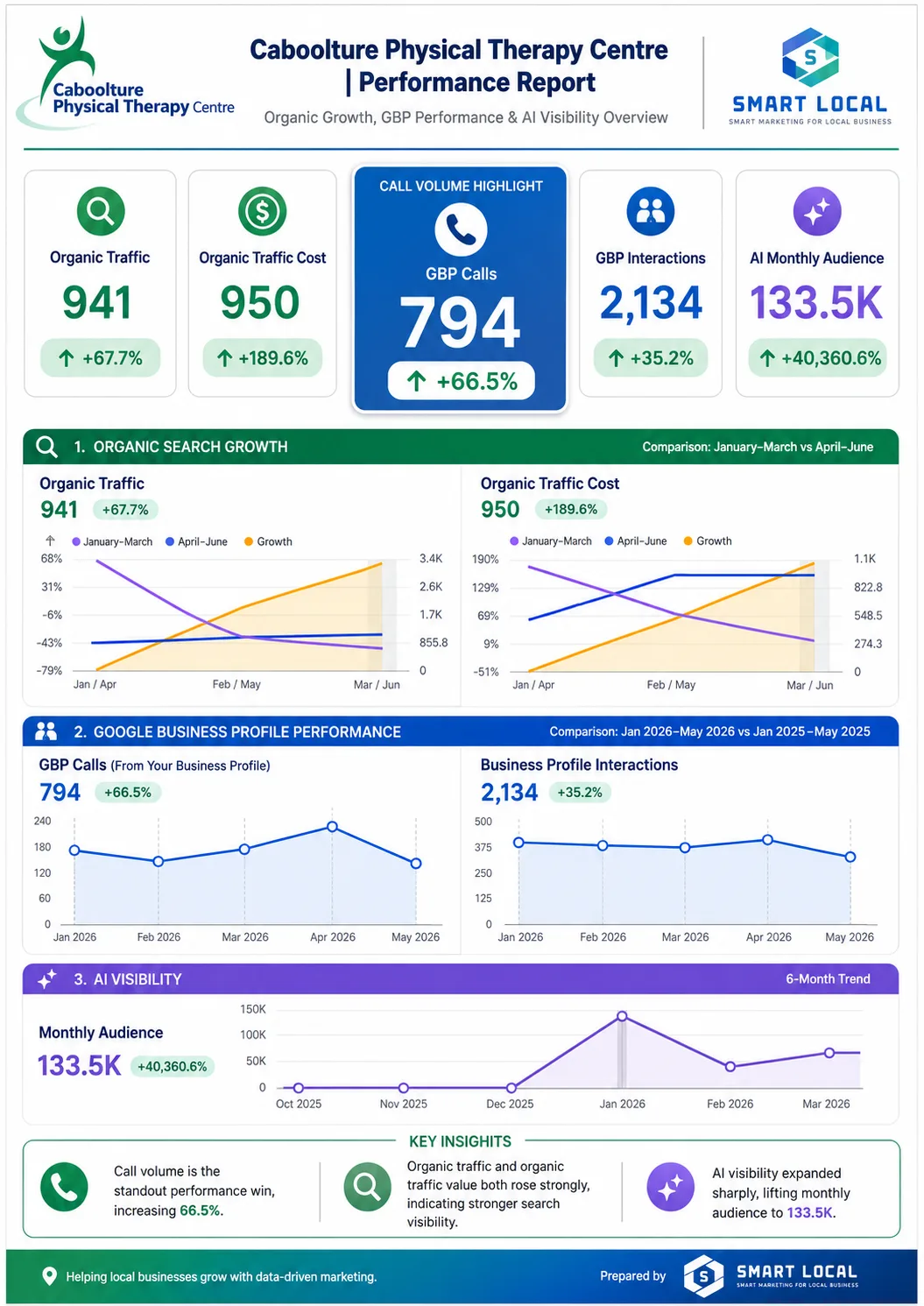
The results are measurable. Caboolture Physical Therapy Centre grew its organic traffic by 67.7% with us.
This suits any local business whose customers ask "who should I call". Tradies, clinics, law firms and home services are the closest fit, because AI answers those questions with short local shortlists.
Running the platforms as one programme stops you paying for the same fix four times. A crawler rule corrected once in robots.txt, a licence number added once to a service page or a Business Profile updated once can feed every platform that reads those sources. So the plan starts from the shared inputs and adds each platform's extras on top.
What's included
AI readiness audit
We map where your business stands across ChatGPT, Google AI Overviews and other platforms before any work starts. The audit asks each platform the local questions your customers would ask, records who gets named and what is said about you, and lists the gaps in your site, listings and reviews most likely to explain the result.
Crawler and technical access
The platforms have to be able to read your site before content matters. We check robots.txt and any firewall or CDN rules for Googlebot, Bingbot, OAI-SearchBot and PerplexityBot, confirm key pages are indexed, keep important content in text rather than images or scripts, and make sure structured data matches what the page shows, both of which [Google recommends for sites that want to appear in its AI features](https://developers.google.com/search/docs/appearance/ai-features).
Content structured for AI
Clear headings, direct answers and clean markup, so AI systems can read your pages and quote them. Each service page opens with a plain answer to the question it targets, then covers what drives the price, how the job runs, where you work and your credentials, in sections a reader or a model can lift on their own.
Entity, schema and credential signals
Consistent business details and structured data that tell AI exactly who you are and where you operate. The work also puts the credibility facts on the page: the owner or practitioner's name and role, licence or registration numbers, and dates on content. Google's guidance on helpful content encourages accurate bylines wherever readers would expect one.
Review and citation building
Genuine reviews and mentions on trusted platforms, the raw material AI models use to judge credibility. Reviews are requested from every customer in the same way, because Google's Maps content policy prohibits offering incentives for reviews or selectively soliciting positive ones.
Question and intent mapping
Your content matched to the real questions customers ask AI tools while deciding who to hire. Those questions run longer than typed searches, for example "who can fix a leaking hot water system in Buderim today", so the map groups them by service, suburb and urgency and gives each group a page that answers it.
AI visibility reporting
Monthly reporting on where your brand appears in AI answers and what we're changing next. Each report keeps what was measured apart from what was changed, so a movement can be traced to a likely cause or set aside as normal variation between answers.
An AI search optimisation framework in five stages
AI search optimisation runs as five stages in a fixed order: access, content, entity and listings, mentions, then measurement. Each stage rests on the one before it, and each lines up with a part of Google's guide to optimising for generative AI features, which at the time of writing (October 2026) says those features rely on Google's core Search ranking systems to retrieve pages from its index. The audience is large: Google said in its June 2026 investor presentation that AI Overviews had over 2.5 billion users each month. The same inputs serve ChatGPT, Perplexity and Copilot, so each stage is done once and checked against every platform.
Access trips up more local sites than people expect, usually through two crawler distinctions. OpenAI's crawler documentation separates OAI-SearchBot, which surfaces websites in ChatGPT's search features, from GPTBot, which collects content that may be used to train its models, so a site can decline training without dropping out of search answers. Google draws a similar line: its crawler documentation says Google-Extended governs use of content for Gemini training and grounding and does not affect inclusion or ranking in Google Search. Blocking the wrong one by accident is among the first things the audit looks for.
| Stage | What the work does | What the platforms document |
|---|---|---|
| 1. Access | Checks robots.txt, firewall and CDN rules for Googlebot, Bingbot, OAI-SearchBot and PerplexityBot, and confirms key pages are indexed | Google: supporting links must be indexed and eligible to show with a snippet, with crawling allowed in robots.txt and by any CDN or hosting infrastructure |
| 2. Content | Service pages that open with a plain answer, keep important content in text and cover cost drivers, process, service area and credentials | Google: create valuable, non-commodity content; there is no need to break content into tiny pieces or write in a special way for AI |
| 3. Entity and listings | Matching name, address, phone and hours across the site, Google Business Profile and Bing Places, with structured data that matches the page | Google: Business Profiles can help visibility in AI responses, and no special schema.org markup is required; Microsoft: keep Bing Places details current for location-based questions |
| 4. Mentions | Reviews requested from every customer, plus listings on association, supplier and local sites | Google Maps policy: no incentives for reviews and no selective requests for positive ones |
| 5. Measurement | Each platform's own report plus a fixed set of local questions re-checked on a schedule | Google: the Search Console Generative AI performance report; Microsoft: AI Performance in Bing Webmaster Tools |

Choosing who to hire for AI search visibility
Hire a provider who can show you each stage of the work and who tells you plainly what they cannot control. Whether a platform names your business is decided by that platform's own systems, which is why AI visibility differs by product. Google's own guide says no third-party tool has access to its internal ranking or AI systems, so a promise of placement is a reason to keep looking.
Our guide to choosing an SEO company covers the wider vetting questions, and our guide to comparing AI visibility reports explains how to read the tracking a provider sends you. The questions below are the ones specific to AI search work, and they apply to us as much as to anyone else.
- Which crawlers will you check?A useful answer names Googlebot, Bingbot, OAI-SearchBot and PerplexityBot, and covers firewall and CDN rules as well as robots.txt.
- What will change on my site and listings?Expect named pages, listings and business facts to be fixed, not a general promise to optimise for AI.
- How will you measure it, and what can't the reports show?Every platform report has limits, and a provider should explain them before the first report arrives.
- Are you selling special AI files or markup?Google says Search doesn't use llms.txt and needs no special schema for its AI features, so these shouldn't be the centre of a quote.
- What do you need from me?Access to your website and Business Profile, licence or registration details, job photos and a list of the associations and suppliers you deal with.
- Who checks the facts before they go live?A named person should approve every claim about your business, because AI answers draw on what your pages and listings say.
AI search optimisation and SEO, side by side
Most of the work is ordinary SEO done carefully. Google says there are no additional requirements to appear in AI Overviews or AI Mode, and that a page has to be indexed and eligible to show with a snippet. What changes is where the business appears, how success is measured and how many crawlers need access.
The last row is why the two belong in one plan. Google's guide to generative AI features says Search doesn't use llms.txt files, and that content needn't be broken into tiny pieces or written in a special way for AI. Budget spent on AI-only tricks is usually better spent on the pages and listings both kinds of search read.
| Question | Classic SEO | AI search optimisation |
|---|---|---|
| Where you appear | A ranked list of links and the Maps results | Named, quoted or linked inside a generated answer |
| What success looks like | Rankings, clicks, calls and form enquiries | Being included, and described correctly, across a set of real customer questions, plus the visits those answers send |
| How questions are asked | Short typed searches | Longer conversational questions; Google describes its AI features running a set of related queries to gather more results |
| Which crawlers need access | Mainly Googlebot and Bingbot | Those two plus OAI-SearchBot and PerplexityBot |
| What stays the same | Indexable pages, helpful content, accurate listings, genuine reviews | All of the same, with no special AI files required by Google |
Mentions beyond your own website
AI answers draw on what other sites say about a business, so part of the work happens away from your website. Microsoft's announcement of AI citation reporting in Bing Webmaster Tools advises businesses to register with Bing Places for Business so details such as address, hours and contact information stay current. For a small local firm, the useful third-party sources are usually close to home.
Paid link schemes and invented reviews are left out entirely. Your side of the work is small but can't be skipped: access to your Google Business Profile and website, a list of the associations and suppliers you deal with, licence or registration details, job photos, and sign-off on every business fact before it is published.
- Industry associationsMember directory pages from a trade or professional body you already belong to.
- Supplier and manufacturer listings"Find an installer" or stockist pages run by brands you install or sell.
- Local business groupsChamber of commerce and business network member listings for your town.
- Local news and community sitesCoverage of a genuine local project, sponsorship or event, earned on its merits.
- Directories and listingsGoogle Business Profile, Bing Places and the main directories, with identical name, address and phone details, the layer our citation building service covers.
A worked example, and how results are measured
Say a plumbing business in Caloundra (a hypothetical example, not a client) wants to know why ChatGPT names two competitors when customers ask for a plumber in Caloundra. An audit along these lines might find three things: a firewall rule from its web host that blocks unfamiliar bots, OAI-SearchBot included; Business Profile hours that no longer match the website; and service pages that never show the QBCC licence number, which the QBCC says licensees must include in their advertising, websites included.
The fixes are unglamorous: allow the crawler, align the hours everywhere, add the licence number and the owner's name to each service page, and ask every recent customer for a review. OpenAI says robots.txt changes can take about 24 hours to register with its systems, and new pages still have to be found and read, so the business would then watch the same questions month by month. Whether ChatGPT names it afterwards is the measure, and an honest report allows that it may not.
Measurement uses each platform's own report where one exists and a fixed question set where none does. None of them is a ranking, and answers vary from one run to the next, so a trend over several months counts for more than any single check. Visits from tools such as ChatGPT and Copilot appear in GA4's AI Assistant channel, while Google's AI Overviews and AI Mode are counted as Organic Search. Google's help page also warns that AI Overviews can and will make mistakes, so the check covers what is said about you as well as whether you're named. Our guide to comparing AI visibility reports covers how to read these numbers.
| What is measured | Where it comes from | Its limits |
|---|---|---|
| Impressions in AI Overviews and AI Mode | Search Console's Generative AI performance report | Impressions only, with no click data |
| Visits from ChatGPT, Gemini, Copilot and similar tools | GA4's AI Assistant channel | Visits from Google's AI Overviews and AI Mode are counted in Organic Search instead |
| Citations in Copilot and Bing AI summaries | Bing Webmaster Tools AI Performance report (public preview) | Microsoft surfaces and select partners only |
| Whether you are named, and described correctly | A fixed set of local customer questions checked on a schedule | A sample of answers that change between runs, not a rank |

Built for your local market
On the Sunshine Coast, AI answers to "who should I call" name two or three local businesses and stop there. The pool of recommended names in each suburb is small, and it favours whoever built trust signals first.
We shape your strategy around your real service area, suburb by suburb, so AI recommendations match where you actually work.
Questions we get asked
What is AI search optimisation?
AI search optimisation is the work of making your business easy for AI platforms such as ChatGPT, Google AI Overviews and Microsoft Copilot to find, read and recommend. As a service it covers crawler access, service pages that answer customers' questions directly, consistent business details and structured data, genuine reviews, and mentions on sites those platforms already read, then reports on where your business is named and how it is described.
What else is AI search optimisation called?
AI search optimisation also goes by generative engine optimisation (GEO), answer engine optimisation (AEO) and LLM SEO, and AI SEO is the umbrella term. The work overlaps heavily: GEO and AEO describe the same goal of appearing in AI answers, while LLM SEO focuses on large language model assistants. We keep separate pages for generative engine optimisation and LLM SEO; this page covers running the work as one programme across the main platforms.
How is AI search optimisation different from SEO?
AI search optimisation differs from classic SEO in where your business shows up. Classic SEO ranks your pages in a list of results; AI search optimisation gets your business named inside the answer itself, where tools like ChatGPT and Google AI Overviews name a few trusted sources. They share foundations and work best run together, and Google says normal SEO practice still applies to the AI features in its search.
Does AI search optimisation cover Microsoft Copilot?
Yes, AI search optimisation covers Microsoft Copilot as part of the same programme rather than as a separate service. At the time of writing (October 2026), the AI Performance report in Bing Webmaster Tools, still in public preview, shows how often your pages are cited in Copilot and Bing's AI summaries and the grounding queries behind those citations. The Copilot work adds Bing Webmaster Tools, IndexNow where your site supports it, and a Bing Places listing that matches your Business Profile.
Do small businesses need AI search optimisation?
Small businesses need AI search optimisation when their customers ask AI tools who to call, because those answers name a short list of local firms. Tradies, clinics, law firms and home services are the closest fit. Most of the work also strengthens your local SEO: crawler access, clear service pages, accurate listings and genuine reviews. A strong Google ranking helps but won't necessarily get you named, so an AI readiness audit shows where you stand before any work starts.
How do I choose who to hire for AI search visibility?
Choose an AI search optimisation provider who explains each stage of the work, names the crawlers and listings they will check, and says plainly that nobody controls whether an AI platform names you. Be wary of promised placement, or of quotes built around special AI files Google says it doesn't use. Our guides to choosing an SEO company and comparing AI visibility reports list the questions worth asking.
How long does AI search optimisation take?
AI search optimisation has no fixed timeline, because each step waits on someone else's system. Crawler changes register quickly, but pages still need recrawling and indexing, reviews build one customer at a time, and directories update listings on their own schedules. Expect the audit and access fixes first, then judge content and mentions over several months of repeat checks. Our guide to how long local SEO takes explains the same dependencies.
What drives the cost of AI search optimisation?
The cost of AI search optimisation follows the size of the job more than the number of platforms. The main drivers are how many services and locations need covering, the condition of your current site and listings, how much new content is needed and how many third-party listings need correcting. The AI SEO pricing page explains how scope shapes cost for this kind of work.
Keep exploring

Want the phones ringing?
Tell us your suburb and your trade. We'll show you which searches and suburbs we'd target first.