
Conversion Rate Optimisation for Australian Service Businesses
Smart Local runs conversion optimisation for Australian service businesses. A conversion is a visitor taking the action you want, such as an enquiry, a booking or a purchase. Conversion work goes deeper than tweaking a few buttons, and the real job is finding the friction that makes visitors leave, then removing it. The service includes an audit of the path people take through your site, which finds where they drop off, what is causing the friction, and where the biggest opportunities sit. Smart Local has built more than 200 websites and generated more than 1,000,000 leads for clients. Send through your site address and say what you want people to do on it.


Who Needs Conversion Work, and Where They Are Searching From
Conversion work goes deeper than tweaking a few buttons, and the real job is finding the friction that makes visitors leave, then removing it.
At the last count there were 2,814,778 actively trading businesses in Australia, and most of them run with no employees at all or fewer than five. In a single year, 460,461 of them opened and 375,331 closed. An owner working at that size does not get many goes at a visitor.
Here is where the searching happens. Over the past three months Google showed a Smart Local page to people searching for conversion rate optimisation in Brisbane 151 times and on the Sunshine Coast 24 times. The same wording came up with the Gold Coast on the end, with Logan City, with Townsville. Most of those searches carried a place name with them. A handful left the place name off and searched for a conversion optimisation company or a conversion optimisation service, and one asked for it Australia-wide.
Smart Local works with trades and service businesses in Brisbane, on the Sunshine Coast and across regional Queensland.
So the audit does the sorting. It finds where visitors drop off on your site, what is causing the friction, and where the biggest opportunities sit. From there the changes go into landing page structure and messaging, calls to action, forms and navigation, and get put against real user data rather than assumed. Tracking and conversion reporting cover the conversion rates, behaviour and leads.
Problems we fix
Plenty of people visit the site and almost nobody makes contact.
Something in the path is making visitors leave before they act. Conversion work goes deeper than tweaking a few buttons, and the real job is finding that friction, then removing it. On a lower-traffic site, every visitor has to count. A conversion audit looks at the path people take through the site and finds where visitors drop off, what is causing the friction, and where the biggest opportunities sit.
Landing pages pull visitors in and then lose them.
The structure, the messaging or the flow of the page is not carrying people toward an action, so they bounce instead. On a high-traffic site even small improvements can produce a serious lift in leads and revenue, and on a lower-traffic site every visitor has to count. Landing page structure, messaging and flow are refined so more visitors take action instead of bouncing.
Visitors get to the bottom of a page and are not sure what to do next.
The call to action is not clear enough or strong enough to guide people toward an enquiry, a booking or a purchase. Those actions are what the conversion reporting counts, alongside conversion rates and behaviour. Calls to action are made clearer and stronger, so people are guided toward an enquiry, a booking or a purchase.
The enquiry form asks for a lot and people give up part way through.
Forms carry friction, and trimming them back is what reduces it and lifts submissions. Submissions are counted as leads in the conversion reporting. Forms are trimmed back to reduce friction and lift submissions, while still capturing what you need.
The site is slow and awkward to move around.
It is one more piece of friction between the visitor and the action, and removing friction is the core of the work. Faster, easier navigation helps visitors convert and helps search engines read your site. User experience work goes into faster, easier navigation across the pages that matter to conversion.
Changes get made on a hunch and nobody can tell whether they helped.
The versions were never put against real user data. Tested improvements compound over time. A/B testing runs different versions of pages, headlines and elements against real user data, and tracking and conversion reporting give you clear numbers on conversion rates, behaviour and leads so you know what to fix next.

What Smart Local Changes on Your Website
The work breaks into seven parts.
The audit is the one that finds the targets. It looks at the path people take through your site and finds where they drop off, what is causing the friction, and where the biggest opportunities sit. The other six do the fixing and the checking: landing pages, calls to action, forms, navigation, testing and reporting.
Those parts are wired together. Your conversion strategy is connected to your traffic sources, landing pages, messaging and user journey, so the whole system converts together instead of one page at a time.
Why Big Sites and Small Sites Need Different Work
Two businesses can run the same website design and still have completely different conversion problems, because every business has a different audience, traffic mix and customer journey, and that changes where the conversion gains are hiding.
Traffic volume is the clearest split. On a high-traffic site, even small improvements can produce a serious lift in leads and revenue. On a lower-traffic site, every visitor has to count, so the work goes into removing friction and guiding people clearly toward action.
Either way, the audit finds where visitors drop off on your own site, what is causing the friction, and where the biggest opportunities sit.
How Your Traffic Source Changes What Needs Fixing
Every strategy is built around how your customers actually behave, whether they arrive from Google Ads or organic search.
A conversion problem is rarely stuck on one page, which is why your conversion strategy is wired into your traffic sources, landing pages, messaging and user journey, so the whole system converts together instead of one page at a time.
Which version works better gets settled by testing rather than by opinion, with different versions of pages, headlines and elements run against real user data so improvements compound over time.
How You Will Know Whether It Is Working
A conversion rate is the share of visitors who take the action you want, and that action is an enquiry, a booking or a purchase.
Tracking and conversion reporting give you clear numbers on conversion rates, behaviour and leads, so you know what is working and what to fix next. A/B testing runs different versions of pages, headlines and elements against real user data, so improvements compound over time.
No set conversion rate is promised with any of that. Every business has a different audience, traffic mix and customer journey, and that changes where the conversion gains are hiding. Under Australian Consumer Law, any performance claim a business advertises has to be accurate, truthful and based on reasonable grounds, and a claim can mislead even when nobody meant it to.
What to Ask Any Conversion Optimisation Provider
Put these to everyone you are talking to, Smart Local included.
Ask which client every number belongs to. Under Australian Consumer Law, any claim a business advertises about its services has to be accurate, truthful and based on reasonable grounds, and it has to be able to prove it.
Ask what happens if you want to stop. Smart Local operates a no lock-in contracts policy.
Ask what will actually change on the site. Smart Local's list is an audit of where people drop off, landing page structure and messaging, calls to action, forms, navigation, testing and reporting.
Ask how you will hear about it while it runs. You will know what is happening as the work goes on, with real testing and ongoing changes based on what is generating results.
If the same provider also sells you SEO, ask whether they will guarantee a number one ranking. Google's own guidance says no one can, and it warns buyers away from any SEO that guarantees rankings or claims a special relationship with Google.
Conversion Results Smart Local Has Recorded
Two conversion results from Smart Local clients.
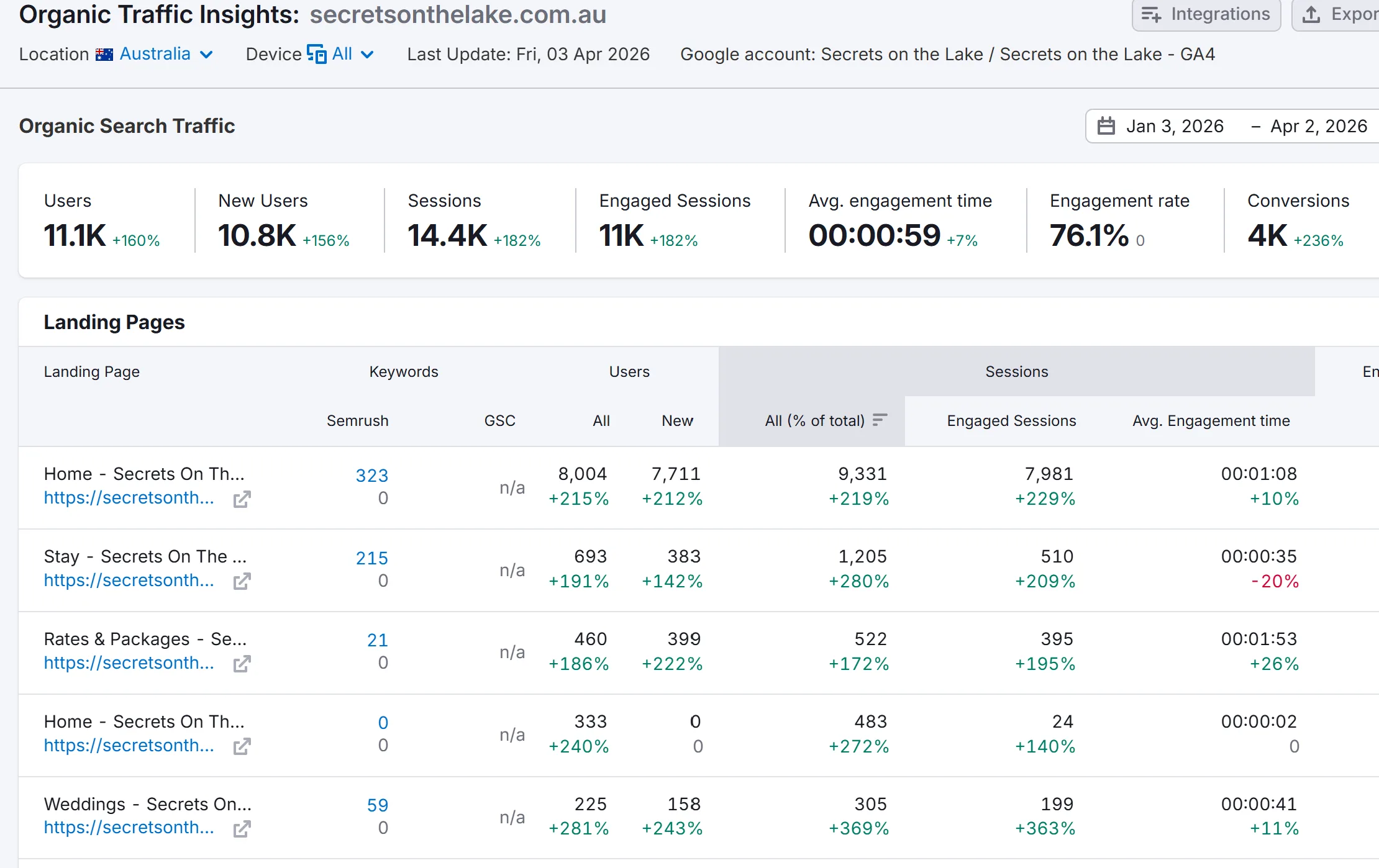
Secrets on the Lake, a venue at Montville, had website conversions rise 236% in 90 days. Bob Gunn Termite Solutions had Google Ads conversions rise 124.3%, with the cost of each conversion falling 20.5%.
Both are records of work already done for those clients. What moves on your own site depends on your audience, your traffic mix and your customer journey.
Smart Local has worked in digital marketing for more than 20 years. It has built more than 200 websites and generated more than 1,000,000 leads for clients, with more than 1,000 documented client success stories on record. Smart Local has helped businesses across many industries turn underperforming websites into steady lead generators, and holds that this experience is what shows which changes actually move conversion rates and which are guesswork. You will know what is happening as the work goes on, with real testing and ongoing changes based on what is generating results. Smart Local operates a no lock-in contracts policy.
Questions we get asked
What counts as a conversion?
A conversion is a visitor taking the action you want, such as an enquiry, a booking or a purchase. Tracking and conversion reporting give you clear numbers on conversion rates, behaviour and leads, so you know what is working and what to fix next.
How much does conversion optimisation cost?
Smart Local operates a no lock-in contracts policy, so there is no fixed term to commit to. The work itself changes from site to site, because every business has a different audience, traffic mix and customer journey, and that changes where the conversion gains are hiding. Ask through the contact page.
Can you promise my conversion rate will rise by a set amount?
No, because every business has a different audience, traffic mix and customer journey, and that changes where the conversion gains are hiding. Under Australian Consumer Law, any performance claim a business advertises has to be accurate, truthful and based on reasonable grounds, and it can mislead even when nobody meant it to. What can be shown is work already done: Secrets on the Lake, a venue at Montville, had website conversions rise 236% in 90 days.
How long before anything changes?
One record: Secrets on the Lake, a venue at Montville, had website conversions rise 236% in 90 days, which is work already done for that client. Every business has a different audience, traffic mix and customer journey, and that changes where the conversion gains are hiding. A/B testing puts different versions of pages, headlines and elements against real user data, so improvements compound over time.
Do I need a new website before this can work?
The service works on the site you already have, covering landing page structure, messaging and flow, calls to action, forms, and faster and easier navigation. Smart Local has also built more than 200 websites.
Will this help my Google rankings as well?
The user experience work goes into faster, easier navigation, which helps visitors convert and helps search engines read your site. On rankings themselves, Google's own guidance says no one can guarantee a number one ranking, and it warns buyers away from any SEO that guarantees rankings or claims a special relationship with Google.
Am I locked into a contract?
Smart Local operates a no lock-in contracts policy. You will know what is happening as the work goes on, with real testing and ongoing changes based on what is generating results.
Keep exploring

Want the phones ringing?
Tell us your suburb and your trade. We'll show you exactly where the calls will come from.