
Marketing for law firms, proven on two real firms
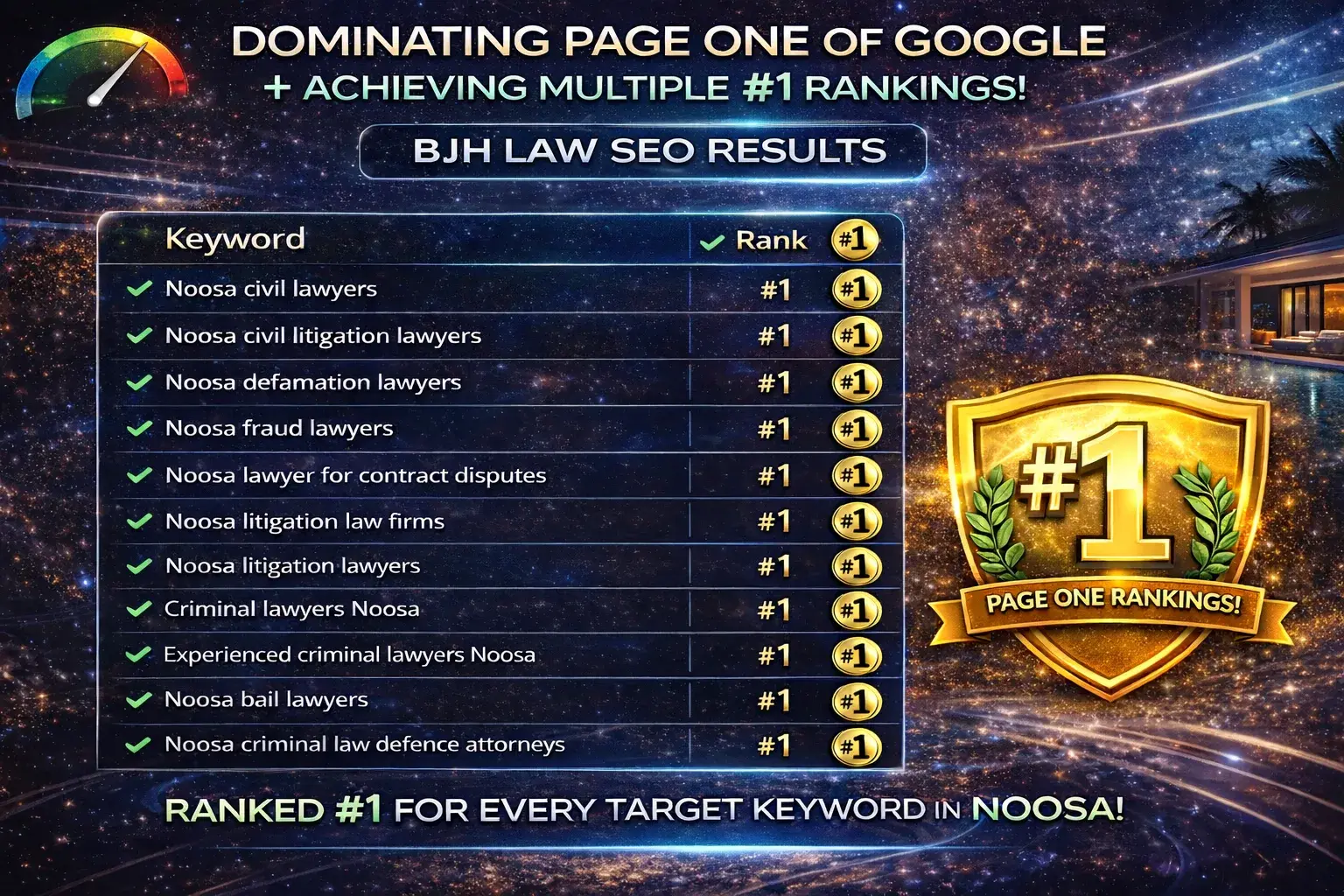
Every target keyword for BJH Law in Noosa sits at number one. Choosing a lawyer is a careful, high-stakes search, and it is the one we worked on for that firm. SEO for lawyers starts from the matters a firm takes: each of those practice areas gets a page that can be found where your clients live, written inside the professional conduct rules, so the enquiries that arrive are for work the firm can accept.

Why law firms work with us
Nobody searches for a lawyer casually. Whether it's a property settlement, a dispute or a criminal charge, the person searching judges every firm by the first page of results.
Rankings carry extra weight in law because clients can't easily compare the work itself. The firm that ranks first and reads credibly gets the call.
We've done this for two firms. BJH Law in Noosa holds first position for all eleven target keywords, and Catton Roderick Lawyers grew website users 445% in five months.
We write with the restraint a firm needs. Plain, accurate pages about your practice areas, with no promises about outcomes. The same restraint applies to our own terms: no lock-in contracts.
A poor-fit enquiry costs a firm more than a lost hour. Someone has to take the call, check for conflicts and explain why the firm can't act, and a person in a hard spot leaves without help. So the work starts from your intake rules: the practice areas you act in, the courts and regions you cover, and the matters you refer on. Pages, forms and ads are then built to say those things plainly, before anyone picks up the phone.
What we run for law firms
Practice-area pages
Family law, conveyancing, wills and estates, litigation and criminal matters each ranked separately, because that's how clients search. Each page covers who the work is for, how a matter usually runs at your firm, what to bring to a first meeting and how fees are explained, in your words. Sub-matters with real demand, such as property settlement or estate disputes, get their own section or page so one long page isn't trying to answer everything.
Local SEO for your office
A firm's catchment follows its court registry and its community. We build visibility where your clients actually are. That includes consistent name, address and phone details across legal directories and listing sites. Those listings are links to the firm, and Google's Business Profile Help names links and reviews among the signals of prominence, one of its three local ranking factors with relevance and distance. The same help page says there's no way to pay for a better local ranking.
Authority content with visible trust signals
Plain-English articles answering the questions people search before they ring a lawyer, written carefully so they inform without giving advice. Google's guidance on helpful content says trust matters most, gives extra weight to topics that affect financial stability and wellbeing, and asks whether it's clear who wrote a page. So articles carry a named practitioner as author or reviewer, a profile page with their admission and practice areas, and the date the content was last checked.
Google Business Profile management
An accurate, active profile with considered review replies, handled with the discretion legal work demands. Google's guidelines give a practitioner their own profile, named for the practitioner only, if they work in a public-facing role and can be contacted directly at the verified location during stated hours; the firm then keeps a separate profile for the office. A sole practitioner at a branded firm shares one profile instead, named in the form "[firm]: [practitioner name]". We set up which profiles your firm should have, the primary category, and the business name exactly as it appears on your signage, with no keywords added.
Review handling for professional services
Encouraging reviews from the right matters and responding without breaching confidentiality. Google's review policy prohibits offering incentives for reviews and selectively asking only happy clients, so the request goes to every client at the end of a matter, the same way. Replies thank the reviewer and never confirm a matter, its facts or its result. Our [reputation management](/services/reputation-management/) process sets the wording with you.
AI search visibility
Some people now put their legal questions to AI tools. We work to make your firm the name those answers mention. Google says there are no extra requirements or special optimisations for AI Overviews or AI Mode beyond being indexed and eligible for a snippet, so the work is the same groundwork: clear practice-area pages, accurate firm facts and consistent listings. No one can promise an AI product will mention a firm.
Technical health and redesigns
Pages that load quickly on a phone, can be crawled and indexed, and keep their rankings through a rebuild. Before a firm changes website or domain, we map every old URL to its new page and set permanent redirects, using our [migration handover](/resources/website-migration-seo-handover/) checklist, so years of practice-area pages don't drop out of search.
What legal marketing can and can't say in Queensland
Legal advertising has its own rules, and SEO copy is advertising. The Queensland Law Society's guidance on rule 36 of the Australian Solicitors' Conduct Rules says a solicitor or principal must ensure advertising isn't false, misleading or deceptive, offensive, or prohibited by law. The same guidance notes the Australian Consumer Law's bans on misleading conduct also apply in Queensland through the Fair Trading Act 1989.
Personal injury work carries tighter limits. The Society's guidance points to Chapter 3 Part 1 of the Personal Injuries Proceedings Act 2002, regulated by the Legal Services Commission. Injury services can't be advertised on radio, television, cinema or recorded telephone messages at all. In print and on websites the firm doesn't own, an injury advertisement is limited to the practitioner's and practice's name, contact details and areas of practice, with no pictures or promotional statements. On its own website, a firm may also explain how personal injury law operates and the conditions on which it acts.
We brief copy against these points, but we aren't your lawyers and this isn't legal advice. The firm's principal carries the obligation, so every page, ad and listing goes to a nominated practitioner for sign-off before it publishes.
| Claim you might see | Why it's a problem | What we write instead |
|---|---|---|
| "Family law specialists" | QLS guidance says only QLS Accredited Specialists may use 'accredited specialist' or a derivative, and treats 'specialist' as likely to be one | "Family law is one of our main practice areas", plus accreditation only where a practitioner holds it |
| "We win" or "you will get the result you want" | Promises an outcome the facts may not allow, which risks misleading the reader under rule 36 | How the firm approaches that kind of matter and what a first meeting covers |
| Injury ads on radio or TV, or with photos or promotional lines | PIPA bans injury advertising on radio, television, cinema and recorded phone messages, and limits print and other websites to name, contact details and areas of practice | A plain print or directory listing, with the detail on the firm's own injury pages |
| Past client results quoted on a practice page | Can imply a typical result when outcomes depend on facts the reader doesn't share | General process explanations; any client story only with written consent and the firm's approval |
Matching each legal search to the right page
People search differently at each stage of a legal problem, and one page can't answer all of them. Early on they want to understand the problem. Later they want a firm near them they can trust. The plan gives each stage its own page and links them, so a reader of a guide is one click from the practice-area page and the enquiry form.
The search patterns below are typical illustrations, not keyword data. Before any page is written, the real terms come from your Search Console queries and keyword research for your area.
| Search pattern | What the person wants | Page that should answer | What it must include |
|---|---|---|---|
| how does property settlement work | To understand the process before calling anyone | A practitioner-reviewed guide | General steps, a clear note that it isn't advice, a link to the family law page |
| family lawyer Noosa | A firm close enough to meet | Family law practice page and Business Profile | Office location, areas served, how a first meeting works |
| conveyancing Sunshine Coast | Someone to handle a sale or purchase | Conveyancing page | Who the firm acts for, what the client supplies, how fees are explained |
| [firm name] reviews | Reassurance before booking | Business Profile and review profile | Recent reviews and careful, confidential replies |
| criminal lawyer near me | Fast help, often urgent | Criminal law page, if the firm acts in it | After-hours contact details if offered, and the courts the firm appears in |

Building intake suitability into the pages: a hypothetical example
Say a two-partner firm in Maroochydore acts in family law, wills and estates and conveyancing, doesn't do criminal work, and doesn't take legal aid matters. Its website gets a steady trickle of criminal and out-of-state enquiries that a lawyer has to call back and refer on. This example is hypothetical, not a client. Here's how the pages would be changed to filter those enquiries without turning away the right ones. Our lead qualification guide for lawyers covers the call-handling side.
- Name what you act inThe practice pages and the services on the Business Profile list only the three areas the firm acts in. Criminal law appears nowhere, so the site stops matching those searches.
- State where you actEach page names the Queensland courts and the regions the firm covers, so a person in another state sees the fit before calling.
- Say what you refer onA short line explains that the firm doesn't act in legal aid or criminal matters and points to where help can be found, which keeps the referral polite and quick.
- Ask the right form questionsThe enquiry form asks the matter type from a fixed list, the suburb and whether there's an upcoming court date. It doesn't ask for the story, which keeps confidential detail out of a web form until the firm has checked for conflicts.
- Track by matter typeCalls and forms are logged by practice area, so the firm can see whether wrong-fit enquiries fall after the change.

How an engagement runs, and what's in and out
An engagement usually starts with an audit and moves in this order. The firm reviews every piece of client-facing copy before it goes live.
Some things sit outside the work. We don't give legal advice, decide what your firm may lawfully claim or write reviews. We don't buy links from networks that sell them. No one can guarantee rankings, Maps positions or enquiries, and we don't.
| Stage | The work | What the firm supplies or approves |
|---|---|---|
| Discovery and audit | Search Console and analytics review, technical crawl, Business Profile and directory check, a look at the firms you compete with | Access to Search Console, analytics and the Business Profile; the practice areas and regions you want |
| Strategy | A page plan by practice area and location, tracking set-up, and a priority order | Intake rules: matters taken, matters referred on, courts covered |
| Pages and profiles | New and rewritten practice-area pages, practitioner profiles, listing fixes | A nominated practitioner's sign-off on every page |
| Content and authority | Guides answering pre-enquiry questions, local directory and association listings | Review of each guide's legal accuracy before publishing |
| Tracking and reporting | Monthly report on searches, calls and forms by practice area | Feedback on which enquiries became matters |
Measuring results honestly
Rankings are a means, not the result. The report a firm should get shows how many calls and forms each practice area produced, where they came from, and how many were the right kind of matter. Form submissions and tracked calls are set as key events in Google Analytics 4, which Google describes as the actions that matter to your business. Call tracking ties each call to the page or ad that produced it.
Only the firm knows which enquiries became matters, so the numbers need your input. A short monthly note of which enquiries were retained, by practice area, lets the report show whether the work is bringing in suitable matters rather than more calls. Our call tracking reconciliation guide explains how to match the two without putting client details in a marketing tool.
Where legal clients search
Legal searches pair a practice area with a place. "Family lawyer Noosa". "Conveyancing Sunshine Coast". Ranking for that pairing is the whole game, and it's exactly what we did for BJH Law.
Some matters stay strictly local. Property, family and estate work tends to go to a firm the client can sit down with, which makes suburb-level visibility worth more than broad state-wide reach.
Reputation compounds differently for firms. A strong review profile and a first-page presence reassure referred clients too, because even a personal recommendation gets googled before the first appointment.
Questions we get asked
Do you have results for law firms specifically?
Yes, Smart Local has results for two law firms. BJH Law in Noosa ranks first for all eleven of its target keywords, a set that runs from civil litigation to criminal defence. Catton Roderick Lawyers grew website users 445% in five months. Both are published case studies, so you can check each result for yourself.
What is SEO for law firms?
SEO for law firms is the work of making a firm's practice areas show up when people near it search for legal help. It covers practice-area pages, the Google Business Profile, accurate directory listings, guides that answer early questions and the technical health of the site. For a law firm it also means copy that meets the conduct rules on advertising and enquiry forms that keep confidential detail out until the firm has checked for conflicts.
What is the typical cost of SEO for a law firm?
The cost depends on the scope of the work rather than a standard rate. The main drivers are the number of practice areas that need their own pages, how many offices need profiles and local pages, how competitive each practice area is in your region, how much new content is needed, and whether the site needs technical fixes first. A strategy review sets that scope before any figure is discussed.
Which SEO agency is best for law firms?
The right agency is the one that can show legal results you can check, explains its work in plain terms, and treats the conduct rules as part of the brief. Ask for published case studies, who writes and who reviews the copy, how calls and forms are tracked, and what the contract term is. Our guide to comparing marketing proposals lists the questions to put to each agency.
How long does SEO take for a law firm?
It varies by practice area and market, so no honest agency gives a fixed date. A narrow practice area in a regional town usually moves sooner than a broad term in a capital city, and fixing an existing site is quicker than building authority for a new one. Our guide to how long local SEO takes explains the stages and what to watch in the first months.
Is SEO being phased out?
No. Search is changing shape, but Google says pages need no special optimisation to appear in AI Overviews or AI Mode beyond being indexed and eligible to show a snippet in ordinary search. The groundwork that helps a firm rank, such as clear practice-area pages, accurate firm facts and a well-built site, is the same groundwork those AI features draw on. Our guide to how AI Overviews work covers the detail.
Can you handle a firm with several offices?
Yes, the plan works office by office. Each office that is staffed and open to clients gets its own Business Profile, with the same firm name and its own address and hours, plus a page on the site for that office. Practice-area pages link to the offices that offer that work, so one office doesn't compete with another. Our multi-location SEO page covers how that's set up.
Keep exploring

Want the phones ringing?
Tell us your suburb and your trade. We'll show you which searches and suburbs we'd target first.