
Map Pack SEO: the signals behind Google's top three map results
Map search optimisation services, which Smart Local calls Map Pack SEO, work on the signals Google uses to pick the map pack: the three businesses it shows with a map for local searches. [Google's Business Profile help](https://support.google.com/business/answer/7091?hl=en) names those signals itself: relevance, distance and prominence. Below is what each one means for a local service business, the work that moves each signal, the shortcuts that break Google's rules, and how to judge the result by calls and direction requests rather than one rank number.

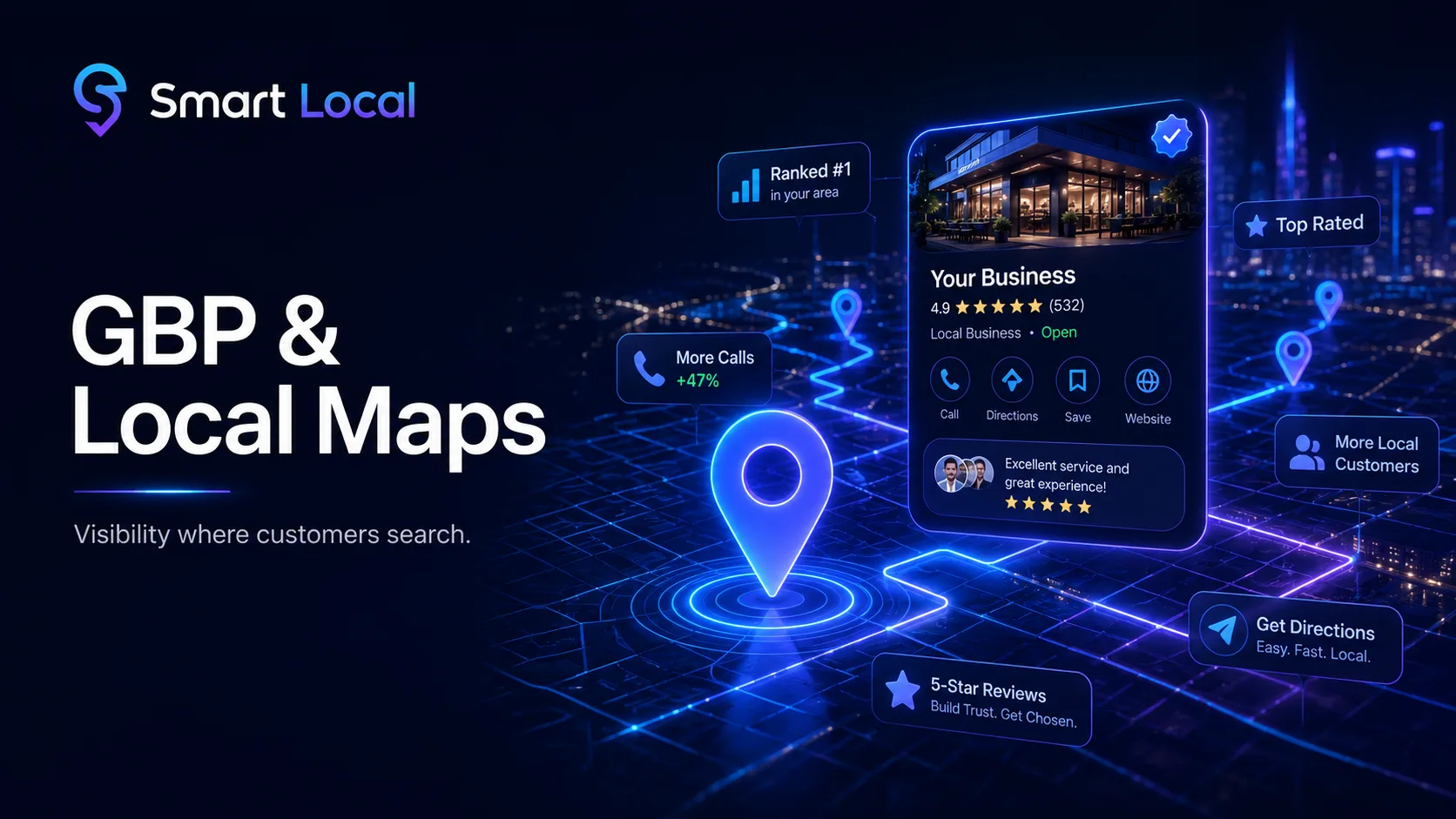
Why choose us for Map Pack SEO
Three spots, and every competitor in town chasing them. Getting in takes more than a tidy Google Business Profile, so we build the signals Google names for local ranking: relevance, distance and prominence.
We study who currently holds the top three for your searches and why. That gap analysis shows exactly which signals you're missing and how much work it takes to close the distance.
Reviews carry serious weight here. Quantity, quality, recency and your replies all count, so we set up a steady review flow instead of a one-off push.
If you reach the pack, the work shifts to holding the spot. Competitors keep pushing, so we keep building. Your reporting shows your position the whole time, and there's no lock-in contract keeping you here.
The profile and the website it links to have to tell the same story. If the profile lists blocked drain clearing and the site never mentions it, Google has less to match a search against, and a buyer who clicks through finds nothing to back the listing up. So the work covers both, plus the listings and links that sit outside your control.
What's included
Map pack gap analysis
We break down the three businesses above you and map the exact signals separating you from them. That means comparing primary categories, listed services, review count and recency, how complete each profile is, whether their websites have a page for the searched service, and where else they're listed. The output is a short, ranked list of gaps, so the first fixes go where the difference is largest.
Google Business Profile tuning
Every field complete, accurate and matched to the searches you want to win. [Google's guidelines](https://support.google.com/business/answer/3038177?hl=en) ask for your real-world business name with no added keywords, as few categories as possible to describe the core business, and regular customer-facing hours. We set those, list services in the words customers use, and add real photos of your work, team and vehicles. Google can also publish edits suggested by users, so the profile gets checked for changes nobody on your side made.
Website and relevance alignment
Categories, services and content shaped around how your customers actually phrase their searches. On the website that means one page per core service, suburb references that are true to where you work, contact details that match the profile word for word, and LocalBusiness structured data repeating those same details. [Google's documentation](https://developers.google.com/search/docs/appearance/structured-data/local-business) describes that markup as a way to tell Google about hours and other business details, so we treat it as consistency work, never a ranking switch.
Citations, duplicates and other maps
Your details made consistent across directories, so Google sees the same business wherever it looks. That includes finding duplicate Google profiles, which Google's guidelines say cause problems with how your information displays on Maps and Search, and checking what Apple Maps and Bing Places show for you. Old addresses and phone numbers left behind after a move are the usual culprits. The directory side is covered in [citation building](/services/citation-building/).
Review engine
A repeatable process for earning reviews and replying to them. Google's Business Profile help says more reviews and positive ratings can help local ranking, and its [Maps content policy](https://support.google.com/contributionpolicy/answer/7400114?hl=en) sets the limits: no payment or discounts for reviews, no asking only happy customers, no reviews from staff, and no requests for specific wording. So the process asks after every finished job, and replies thank the customer in plain language about the work done.
Local links and mentions
Google says prominence also draws on how many websites link to your business. The links worth having are ones a real local business earns through [local partnerships](/resources/local-business-partnerships/): a supplier or trade association that lists its members, a junior sports club you sponsor, the chamber of commerce, a local news story about a job. Google's spam policies class bought links and excessive link swaps as link spam, so those stay off the plan.
Position and enquiry tracking
Your pack position monitored across your suburbs and reported plainly every month, next to the numbers that pay the bills. The [Business Profile performance report](https://support.google.com/business/answer/9918094?hl=en) shows calls from the profile, direction requests, website clicks and the search terms people used. We line those up with [call tracking](/services/call-tracking/) on the website, so a change in position can be read against enquiries instead of on its own.
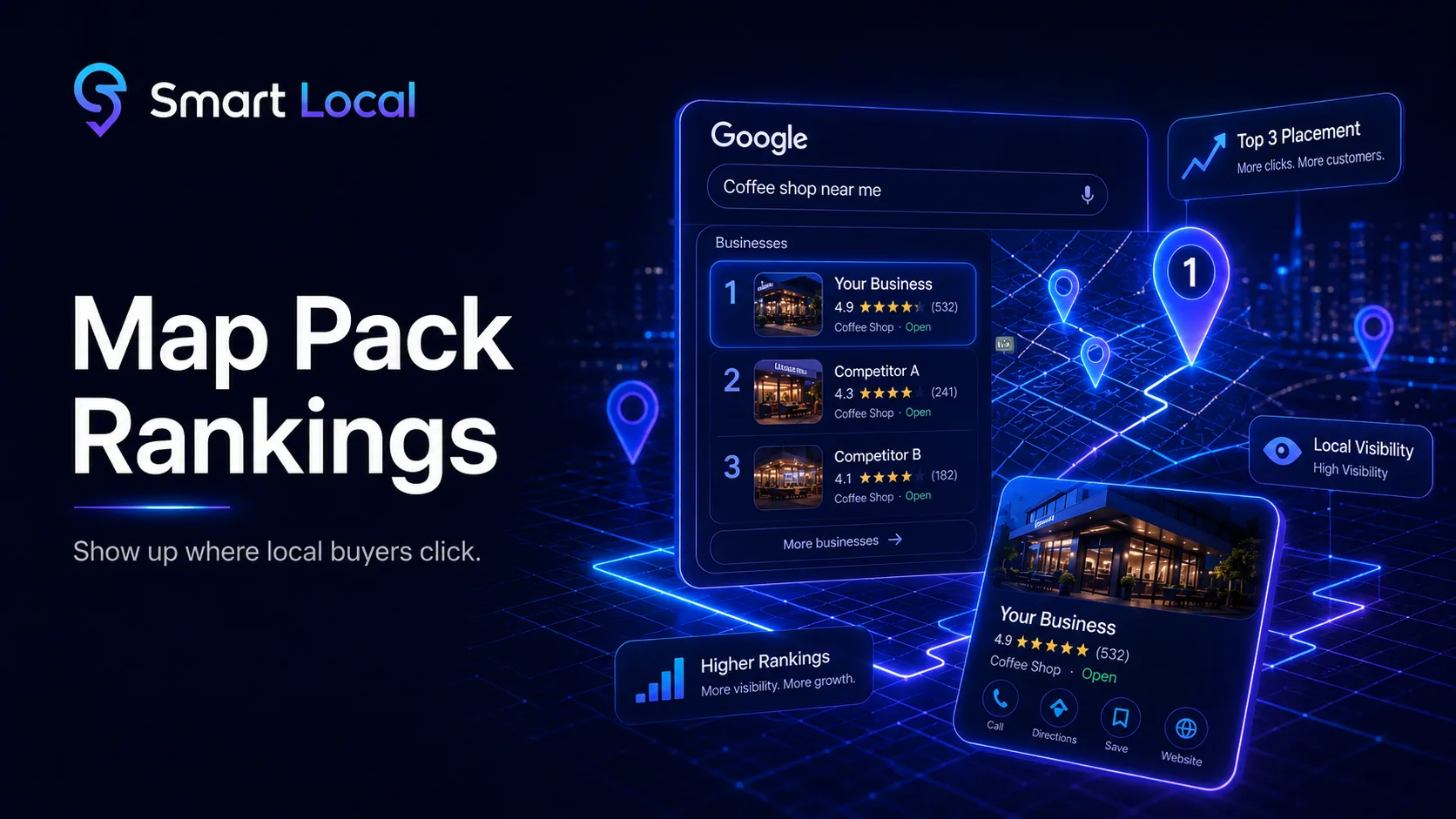
How Google decides the local three-pack
Google's Business Profile help names three factors and explains each in a line. Relevance is how well a profile matches what someone searched for. Distance is how far the business is from the searcher, and when the searcher doesn't share a location, Google uses what it knows about where they are. Prominence is how well known the business is, based partly on how many websites link to it and how many reviews it has.
The three don't leave the same room to move. Distance is mostly set by where you're based and where the searcher is standing. Relevance and prominence are where the work goes. Google doesn't publish a weighting between the factors, so anyone quoting exact percentages for them is estimating, and the same help page states there's no way to request or pay for a better local ranking.
| Factor | What Google says | What you can change | What you can't change |
|---|---|---|---|
| Relevance | How well the profile matches the search | Primary category, services, description, matching service pages on the website | Searches for work you don't do |
| Distance | How far the business is from the searcher | An accurate address or service areas and a correctly placed pin | Where the searcher is when they search |
| Prominence | How well known the business is, including links and reviews | Review flow, replies, local links and mentions, consistent listings | A competitor's review history built up over years |
| Payment | No way to request or pay for a better local ranking | Running ads on Maps as a separate channel | The organic order of the pack |

How a map pack engagement runs, in order
The order matters because some problems undo other work. A profile with keywords stuffed into its name or a virtual office as its address is at risk of suspension under Google's guidelines, and building reviews onto it first wastes the effort. So an engagement usually runs in this sequence.
- AuditCheck the profile against Google's guidelines first: business name, address or service areas, categories, hours, duplicate profiles and any edits Google published from user suggestions. Guideline problems get fixed before anything else.
- Gap analysisList the searches that bring paying work, record who holds the pack for each one, and compare their categories, services, reviews, website pages and listings with yours.
- FixesCorrect the profile, merge or remove duplicate and outdated listings, and add or rewrite the service pages the profile links to.
- Ongoing buildReview requests after every job, replies, photos of real work, posts, and local links earned through suppliers, associations and community involvement.
- TrackingGrid checks across your suburbs, plus profile calls, direction requests and website clicks, reported monthly.
Why your pack position changes from suburb to suburb
Because distance is one of Google's three factors, there is no single map pack for a search. A buyer in Maroochydore and a buyer in Nambour typing the same words can see different businesses. A report that gives one rank number for a search is describing one point on the map, usually wherever the check happened to run.
A grid check fixes that. It runs the same search from a set of points spread across the area you serve and records where you appear at each. Here is a hypothetical example of how one reads. Say a plumbing business based in Caloundra serves the southern Sunshine Coast. The positions below are illustrative only, never a benchmark or a forecast.
Read as a whole, the grid says something a single rank can't: the business is strong near its base and fades to the north. The honest options from there are to build prominence so the profile competes further out, to add a website page about the drain work it wants in Kawana, or to reach the far suburbs with ads. Moving the listed address to look closer isn't one of them, because Google's guidelines only accept a real location the business operates from. Our page on ranking in more suburbs covers that expansion work.
| Checkpoint | Illustrative position | What it suggests |
|---|---|---|
| Caloundra (base) | 1 | Distance and relevance both working |
| Golden Beach | 2 | Still close enough to hold a spot |
| Kawana Waters | 5 | Outside the three; competitors sit nearer the searcher |
| Sippy Downs | Not in the top 20 | Beyond the range where the profile currently competes |

Shortcuts that break Google's rules
Some tactics sold as map pack SEO break Google's rules, and the cost lands on the business, not the seller. What follows depends on the rule. Google cites Business Profile suspension for a padded business name, restricts a profile's reviews for fake engagement, and can rank a website lower for link spam. These are the ones we decline, with the rule each one breaks and the consequence Google states where it states one.
- Keywords in the business nameGoogle's guidelines say unnecessary information in the name isn't permitted and could result in suspension. The name on the profile is the name on the van and the invoices.
- Virtual offices and mailboxesA rented mailing address the business doesn't operate from isn't eligible for a profile, and a PO box isn't acceptable either.
- Extra profiles for one businessGoogle says there should be only one profile per business. A profile for every suburb served, with no real premises in each, breaks that rule, and Google says duplicate profiles cause display problems on Maps and Search.
- Paid or incentivised reviewsGoogle's Maps policy prohibits reviews paid for directly or in kind, discounts or free work in exchange for reviews, and reviews from staff or anyone with a conflict of interest. Google's page on Business Profile restrictions says it can remove the reviews, stop the profile receiving new reviews or unpublish its existing ones for a set period, and show buyers a warning that fake reviews were removed.
- Review gatingSelectively asking happy customers for reviews, or asking customers to include particular content, breaks the same policy and draws the same review restrictions.
- Bought links and link swapsGoogle's spam policies define link spam as links created mainly to manipulate rankings, including paying for links and excessive link exchanges. The stated consequence falls on the website: it may rank lower or not appear in results at all, and Google can apply a manual action.
Map pack SEO, ads on Maps and Local Services Ads
Google states there's no way to pay for a better local ranking, but there are paid placements around the pack. Google Ads Help describes promoted pins on the map and map search ads in Maps results, which need location assets enabled in the Google Ads account and location targeting. Local Services Ads are a separate product where businesses pay for leads after passing Google's screening, and Google doesn't list Australia as a country where they run. At the time of writing (November 2026), Google's Local Services Help offers country versions for Austria, Belgium, Canada, France, Germany, Ireland, Italy, Spain, Switzerland, the UK and the US, so an Australian business shouldn't plan around them.
The two work side by side. A common split is organic visibility for the suburbs near your base and paid placements for suburbs further out or a service you've just added. The paid side is covered on our Google Ads page.
| Question | Map pack SEO | Ads on Google Maps |
|---|---|---|
| How you pay | For the work on the profile, website and reviews; nothing to Google | A Google Ads campaign budget |
| What it needs | An eligible profile that follows Google's guidelines | Location assets linked to the Business Profile, plus location targeting |
| When spending stops | Built signals stay in place, while competitors keep building theirs | Ad placements stop with the campaign |
| Suits | Steady demand in suburbs near your base | Suburbs outside your organic reach, or a new service |
Three spots decide a lot of local jobs
On the Sunshine Coast, the pack often decides who gets the call. A tradie in Nambour competing for "plumber near me" lives or dies on those three listings.
The good news is that local markets here are winnable. Plenty of pack listings sit on half-finished profiles and stale reviews. A business that builds its signals properly can pass them.
Questions we get asked
What is a map pack in SEO?
The map pack is the group of three Business Profile listings Google shows with a map for searches with local intent, such as an electrician near me or a dentist in Caloundra. Map pack SEO is the work on the profile, the website it links to and the business's reputation that makes it a stronger match for those searches. Because the pack usually appears above the organic website results, it is often the first thing a local buyer sees.
Can a business without a shopfront get into the map pack?
Service-area businesses without a shopfront can have a Business Profile and appear in the map pack for local searches. Google's Business Profile help says a business that doesn't serve customers at its address should remove that address and set service areas instead, up to 20, within about two hours' drive of where it is based. Google doesn't publish how distance is measured for a hidden address, so expect visibility to vary across a large area and check it suburb by suburb. More on this in service area SEO.
How long does map pack SEO take?
Map pack SEO has no fixed timeline, and no one can promise one. Profile corrections, duplicate clean-ups and listing fixes come first and are largely one-off, though Google can take a while to reflect them. Reviews and local links build gradually, so competitive searches usually take months of steady work rather than weeks. Our guide on how long local SEO takes explains which signs of progress to watch in the meantime.
Do photos and posts help map pack rankings?
Photos are in Google's own tips for improving local ranking; posts are not. The tips list adding photos and videos alongside verifying the profile, completing business information, keeping hours current and replying to reviews, without saying how much photos count. Posts aren't mentioned, so treat them as useful to buyers deciding whether to call, not as a known ranking factor. Keep real job photos, the team and the vehicles current.
Does map pack SEO still matter now that Google shows AI answers?
Map pack SEO still matters with AI answers in Search, because in Smart Local's view the groundwork it builds (an accurate profile, genuine reviews and a clear website) also supports a local business in AI search features. At the time of writing (November 2026), Google's guidance on AI features in Search says there are no additional requirements to appear in AI Overviews or AI Mode, and lists keeping Business Profile information up to date among the usual SEO practices. More in whether SEO is dead with AI search.
How do you get into the Google 3 pack?
A business gets into the Google 3 pack when Google judges it one of the strongest matches for the search on the three factors it names for local ranking: relevance, distance and prominence. Distance is mostly fixed, so the work goes into the other two: a verified, complete Business Profile with an accurate primary category, a website page for each core service, a steady flow of genuine reviews with replies, and consistent listings. Start with our Google Business Profile checklist.
How is Map Pack SEO different from normal SEO?
Map Pack SEO ranks your Google Business Profile in the maps block, while normal SEO ranks your website in the organic results below it. The two overlap more than most owners expect: the website the profile links to backs up its services and suburbs, and Google counts the websites linking to your business toward prominence. For the wider Maps app, see our Google Maps ranking service and the guide on how to rank on Google Maps.
Keep exploring

Want the phones ringing?
Tell us your suburb and your trade. We'll show you which searches and suburbs we'd target first.