
How to rank in Google AI Overviews
Google now answers many searches with an AI summary above the links, and AI Mode turns a search into a conversation. Google AI Overview optimisation for a local business is mostly the SEO and Google Business Profile work Google already rewards, aimed at the questions your customers ask before they call. This page covers how Google picks the pages behind those answers, the work involved, what we deliberately leave out, and how visibility gets measured without guesswork. No one can guarantee a business gets named in an AI answer, so the work goes into the things Google says it uses.


What Google's AI looks for
Google AI Overviews lift content they can use cleanly: pages that answer a real question in plain language, with structure the AI can read. Vague pages get skipped, no matter how long they are.
Those answers sit on top of normal Search. Google's guide to optimising for generative AI features says they're "rooted in our core Search ranking and quality systems", and that the system retrieves relevant, up-to-date pages before it writes a response. A page that isn't indexed, or can't show a snippet, can't be one of those sources.
Local signals carry serious weight. Your Google Business Profile, reviews, service areas and suburb pages tell Google's AI who you are and where you work. Those signals decide who gets named for "near me" searches. The same Google guide names Business Profiles as one way to help services show in both AI responses and other Search results.
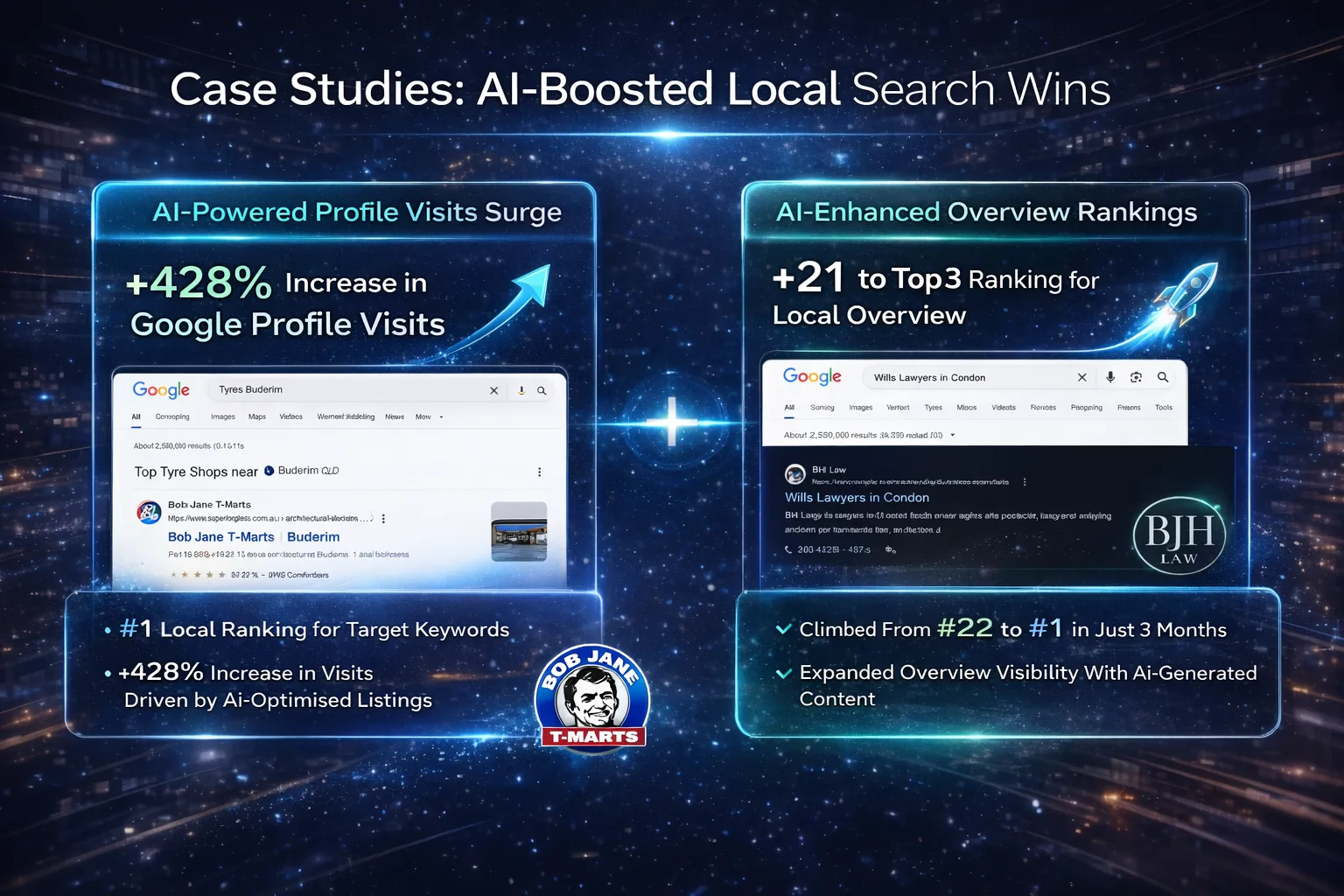
For one client, Bob Jane T-Marts in Buderim, Google profile visits grew by 428% through AI-optimised listings while the store held a #1 local ranking.
Your SEO, Google profile and content run as one system with us, so the same trust signals lift you in normal search, Maps and AI Overviews at the same time.
What's included
Question-led page structure
Service pages built around the questions customers actually type and say, so Google's AI can pull your answers straight into its summaries. Each heading asks one real question and the paragraph under it answers in the first sentence, then gives the detail: what the job involves, what changes the cost, how soon you can attend, which suburbs you cover.
Google Business Profile optimisation
Categories, services, photos and posts tuned so Google's AI reads your profile as a strong, current local source. Hours, service areas and contact details get checked against the website, because a mismatch between the two gives Google conflicting facts about the same business.
Suburb and service area pages
Clear pages for each area you serve, giving the AI the geographic context it needs to name you for local queries. A suburb page earns its place only when it says something true of that area, such as the jobs you do there and how you get there, so thin copies with a swapped suburb name are left out.
Schema and entity markup
Structured data that spells out your business, services and location, as part of standard SEO work. Google says AI Overviews need no special schema. It still asks that markup match the visible text on the page, so we check that before anything goes live.
Review growth and responses
More genuine reviews, answered properly, feeding the trust signals AI Overviews rely on for local picks. That means a simple routine for asking happy customers after the job and replying to every review, including the hard ones. Paid or fake reviews are never part of it.
Listings and genuine third-party mentions
Your name, address and phone number made consistent across the directories and industry sites that already list you, with any wrong details corrected. Google's guide warns that chasing inauthentic mentions doesn't help, so the work stays with real listings and real associations.
AI Overview and AI Mode reporting
We track which queries trigger AI Overviews in your market and whether your business is named, then adjust the plan. The report draws on Search Console's Generative AI performance report, your Performance report, enquiry tracking and dated manual checks of the searches that matter to you.

How Google chooses the pages behind an AI answer
Google describes two steps. First, the system uses its core Search ranking systems to retrieve relevant pages and writes the answer from what those pages say. Second, it uses what Google calls query fan-out: it runs related searches across subtopics at the same time, so the answer can draw on pages that would never rank for the original wording. Google's AI features documentation says this lets AI Overviews and AI Mode show a wider, more diverse set of links than a classic results page.
For a local business, fan-out is the useful part. Say a plumbing business in Caloundra (a hypothetical example) wants to appear when someone asks about a hot water system that's stopped working. The follow-up questions a person would ask next are the ones a fan-out search is likely to cover: repair or replace, what changes the cost, how quickly someone can come out, whether the business works in that suburb. A site that answers each of those on the right page gives Google more than one way to find it. A site with one thin hot water page gives it one.
That's also why organic rankings and AI citations overlap without being the same thing. The table shows what each surface tends to draw on, based on Google's own documentation.
| Surface | What it draws on | What the work covers |
|---|---|---|
| Classic organic results | Core ranking systems: relevance, quality and page experience | Service pages, internal links, technical health |
| AI Overviews | Pages retrieved by core ranking plus fan-out searches on related subtopics | Answer-first pages for the follow-up questions, indexable and snippet-eligible |
| AI Mode | The same retrieval and fan-out, across a longer back-and-forth conversation | Depth on comparisons and decisions, not only the first question |
| Local pack and Maps | Business Profile details, reviews, distance and prominence | Profile accuracy, categories, review routine, consistent listings |

Which of your customers' searches get an AI answer
Google doesn't publish rules for when an AI Overview appears. Its AI features documentation says they're shown only when Google's systems decide they add to classic Search, and that they often don't trigger. So the first job is checking, by hand and in Search Console, which of your customers' real searches show an AI answer in your area and which go straight to the map pack and ads.
The table is the checklist we work from. It sorts searches by type, with no promise about what Google will show on any given day.
| Search type | Example | What we check | Where the answer should live |
|---|---|---|---|
| Urgent or near me | blocked drain Caloundra | Whether a map pack, ads or an AI answer leads the page | Business Profile and the main service page |
| Cost and what drives it | what affects the cost of rewiring a house | Whether an AI Overview shows, and which pages it links | A cost-factors section on the service page |
| Do I need a professional | do I need an electrician to install a ceiling fan | Whether the answer names rules or licences correctly | An FAQ or guide that states the rule plainly |
| Comparison | split system or ducted for a three-bedroom house | Whether AI Mode follow-ups mention local providers | A comparison section or guide linked from the service page |
| Suburb plus service | pest inspection Buderim | Which suburb pages are indexed and linked | A suburb page with genuine local detail |
How the work runs, step by step
An engagement usually starts with an audit and runs in this order, because fixing eligibility before writing new pages saves wasted effort.
- Eligibility checkConfirm the key pages are indexed, crawlable and able to show a snippet. Google's documentation says that's the only technical requirement for AI features. We also confirm the site is set to Include in Search Console's Search generative AI setting, which Google lists as a condition for appearing.
- Search auditList the questions customers ask before they book, then check which show an AI Overview or AI Mode answer in your area and which pages Google links.
- Gap reviewCompare those questions with what your site and profile already answer. Missing answers, wrong facts and pages that bury the answer under an introduction go on the fix list.
- Page and profile fixesRewrite the main service pages answer-first, add real job photos where they help, correct the Business Profile and tidy listings.
- New pages where they're earnedBuild suburb pages and guides only for questions and areas with genuine demand and something true to say.
- Measure and adjustReview Search Console, enquiries and dated manual checks, then move effort toward the searches that bring work.
What we leave out, and why
Plenty of AI Overview advice online contradicts Google's own guidance. These are the tactics we don't sell, with the reason for each. Leaving them out keeps the budget on work Google says it uses.
- An llms.txt fileGoogle's guide says Google Search doesn't use them, and creating one neither helps nor harms visibility in Search.
- Chopping pages into short chunksGoogle says there's no need to break content into tiny pieces for its AI to understand it. Clear headings help readers, so we write for them.
- Rewriting everything for AIGoogle says its systems understand synonyms and general meaning, so repeating keyword variations adds nothing.
- Special AI schemaGoogle says structured data isn't required for generative AI search. Standard business markup stays, for normal rich result eligibility.
- Bought mentions and fake reviewsGoogle's guide says pursuing inauthentic mentions doesn't work. Fake reviews also put the Business Profile at risk.
- Paying to be in the answerThere's no paid route into the organic part of an AI Overview. Ads are a separate product with their own placements.
How visibility is measured, honestly
No single report shows everything, and Google's guide says no third-party tool has access to its internal ranking or AI systems. So we read several sources side by side and say plainly what each can't show.
Here's how that looks in a hypothetical case. Say an electrician's cost page starts showing impressions in the Generative AI performance report. Enquiries for that service are the test of whether it matters, so we check call and form tracking for the same weeks before calling it progress. If impressions rise and enquiries don't, the page probably answers the question but gives no reason to call, and the fix is on the page itself. Our guide to reading Google AI impressions covers this in more detail.
| Source | What it shows | What it can't show |
|---|---|---|
| Search Console Generative AI performance report | Impressions of your links in AI Overviews and AI Mode, by page, country, date and device | Clicks or the searches behind each impression |
| Search Console Performance report | Clicks and impressions under the Web search type, which includes AI feature traffic | Which of those clicks came from an AI answer |
| Google Analytics 4 | Visits from AI Overviews and AI Mode counted in the Organic Search channel | A separate figure for Google's AI features |
| Call and form tracking | Enquiries by page and service | Whether the person saw an AI answer first |
| Dated manual checks | What the answer said on that day and who it named | A stable picture: answers vary between searches and people |

Built for your local market
Sunshine Coast searches are local and specific. People ask for "emergency electrician Buderim" or "physio near Kawana", and Google's AI answers with a short local list. Getting on that list is the whole game.
Google brought AI Mode to Australia in English in October 2025, so the longer, conversational searches it suits are already happening here. A homeowner in Maroochydore can ask which kind of air conditioner suits a humid coastal house and follow up with who installs them nearby. The pages and profile that answer both parts of that conversation are the ones worth building.
Questions we get asked
What are Google AI Overviews?
Google AI Overviews are the AI-written summaries Google shows above the normal results for many searches. They answer the question directly and link to a small number of sources. Google says they appear only when its systems decide they add something to classic Search, so many searches still show the usual results, map pack and ads without one. For a local business they sit alongside Maps, not in place of it.
How do you optimise for Google AI Overviews?
You optimise for Google AI Overviews mostly with normal SEO done well. Make sure key pages are indexed and can show a snippet, answer each customer question plainly near the top of the right page, keep your Business Profile accurate, and support the text with real photos. Google says no special files, schema or writing style are needed. Our AI visibility checklist sets the checks out in order.
Will ranking #1 in Google put me in AI Overviews?
Ranking #1 in Google does not automatically put you in AI Overviews. Google says its AI features are rooted in core ranking systems, so strong rankings help, but the answer also draws on related fan-out searches and may link pages that rank for those instead. Google says that no special optimisation is needed to appear in AI Overviews, and that normal SEO practice is what applies.
Is Google AI Mode better than ChatGPT?
Neither is better for every search, and they work differently. AI Mode is part of Google Search, built on Google's ranking systems with links to web pages, and suits longer questions and comparisons. ChatGPT is a separate product with its own way of finding sources. A local business can appear in both, but each needs its own checks, which our ChatGPT visibility service covers.
Can I pay to appear in Google AI Overviews?
No, you can't pay to be one of the sources Google's AI answer cites. Google Ads Help says ads can show above, below or within AI Overviews in Australia, but those are ads from existing Search, Shopping and Performance Max campaigns. Advertisers can't target that placement directly or opt out of it. Google Ads is a separate budget decision from organic AI visibility.
Can I stop my website appearing in AI Overviews?
Yes. Search Console has a Search generative AI setting that can exclude a site from AI Overviews, AI Mode and generative features in Discover. Google says it isn't a ranking signal for the rest of Search. The nosnippet and max-snippet rules also apply to AI Overviews and AI Mode, though nosnippet removes the text snippet from normal listings too, so most local businesses leave both alone.
Do AI Overviews take clicks from my website?
Yes, AI Overviews take clicks from your website for some informational searches. Google's documentation says clicks from results pages with AI Overviews tend to be higher quality, with people spending more time on the site. For a local service the person still has to call someone, so the page they land on needs a clear reason and an easy way to do it.
How long does AI Overview optimisation take?
There's no fixed timeline, and anyone quoting one is guessing. Timelines depend on your current profile strength, reviews and content, and on how crowded your market is. An indexing or snippet fix only counts once Google recrawls the page, while new pages and a steady flow of reviews build up over months of work. Our guide to how long local SEO takes explains what moves first.
Keep exploring

Want the phones ringing?
Tell us your suburb and your trade. We'll show you which searches and suburbs we'd target first.