
Local SEO Sunshine Coast: What Decides Who Shows Up in the Map Pack
Buderim is where the proof on this page sits: Bob Jane T-Marts, a Smart Local client whose Google Business Profile result is set out in full further down. Holding a local position is different work from winning one. Google orders local results on relevance, distance and prominence, and says there is no way to request or pay for a better local ranking. Distance gets read off the single address on your profile, so the same business is measured against a different field in every suburb it works in. Smart Local runs the profile, the map pack signals and the suburb pages behind it. Send the suburbs you want the phone ringing from, then ask which of them the profile reaches today.

What a Held Local Spot at Buderim Actually Means
Bob Jane T-Marts, a Smart Local client at Buderim, did not win a local position and then leave it alone: the listing held one. A local position is not something you win once and file away, because the field around it keeps moving and a profile nobody maintains slides back down it.
Why a listing can hold a spot at all comes back to how Google orders local results, which it does on three things: relevance, distance and prominence. Google also states there is no way to request or pay for a better local ranking. The three get taken apart further down this page. The one that decides how far your listing travels is distance.
Distance is the factor nobody explains to an owner. It is measured to the single address on the profile, not to the area a van covers. That is why a business turns up in its own suburb and disappears one suburb over, and why the answer is never a bigger radius. Relevance and prominence are the two you can build. Distance is the boundary you build inside.
Buderim is one suburb, and the Sunshine Coast Council local government area holds 2,253.9 square kilometres of very different ground. A listing that holds a spot in one part of that has told you nothing about the rest of it, which is the honest limit on any result, including this one. Billabong Pool Service is the same rule at a larger size: it runs three Sunshine Coast locations, so it has three addresses and three catchments to earn rather than one.
So this page stays on the Google side of a Sunshine Coast business: the Business Profile, the map pack, and the work that decides how far one pin carries. It is written for the owner who already knows they want the map, and who has been quoted for rankings without ever being told what the rankings are made of. Every client result on it names the business it belongs to, because a performance claim has to rest on something a reader can check.
Problems we fix
You show up in your own suburb and vanish one suburb over.
Google names distance as one of the three things that decide a local result, and it gets measured from the single address on your Business Profile. The Sunshine Coast Council local government area covers 2,253.9 square kilometres, and density inside it runs from 2,381.6 people per square kilometre at Mooloolaba and Alexandra Headland down to 20.4 in the Caloundra Hinterland. One pin cannot reach across a spread like that. Relevance and prominence are the two you can build, so the work goes into the listing, the citations and a page for each suburb you service, which is why Billabong Pool Service runs three Sunshine Coast profiles instead of one.
Nobody has opened the profile since the day it was set up.
Of the 39,239 businesses in the Sunshine Coast Council local government area, 23,573 have no employees at all and 10,973 employ between one and four people. A one-person business has no spare afternoon for categories and photos. Relevance is how well the profile matches what somebody types, and an empty service list has nothing to match against. Categories, services, description, hours, photos and the answered questions get rebuilt around a trade plus a suburb, then kept current instead of set once and left.
You are one of 8,376 construction businesses on this coast.
Construction is the largest industry in the Sunshine Coast Council local government area by business count, with 8,376 registered at 30 June 2025, more than one in five of every business in the area. 7,595 of those run on four or fewer employees and only 134 employ 20 or more, and 21,251 businesses in that same council area turned over under $200,000 for the year. Almost none of that field has a marketing budget or the hours to spend it. That makes suburb-level visibility genuinely winnable here, so the work runs as monthly maintenance of a spot rather than a one-off setup, month to month with no lock-in contract.
The businesses you compete with keep changing and nobody told you.
The Sunshine Coast Council local government area's business count rose by a net 1,099 during 2024-25, from 38,140 to 39,239, and across Queensland 88,637 businesses entered the market and 70,459 left it in 2025-26. A listing that ranked two years ago is now up against a field that has partly turned over, so a local spot has to be held rather than won once. Holding one is the measurable part. Bob Jane T-Marts at Buderim held a #1 local ranking while Google profile visits rose 428 per cent, and the arrangement behind that work runs month to month.
You are being chosen by people who have never heard of you.
The Sunshine Coast Council local government area gained 7,659 people during 2024-25, and 7,079 of that gain came from net migration rather than from natural increase. A household that moved up from another state last month has nobody to ask for a plumber or a dentist, so the search has to do the asking. Property turnover feeds the same demand, with 5,576 established house transfers and 3,087 attached dwelling transfers in the same council area in the year to 30 June 2024. Reviews and listing quality get treated as ranking work rather than as admin, because Google counts how well known a business is as prominence.
New-build work is tightening and the map pack is where the rest of it sits.
Building approvals in the Sunshine Coast Council local government area fell from 3,443 private sector dwelling units in the year to 30 June 2023 to 3,219 in the year to 30 June 2025, while the number of construction businesses rose from 7,983 to 8,376 over the same period. More trades chasing fewer new dwellings pushes the money towards repair, renovation and maintenance jobs, and those are the jobs a householder goes looking for rather than puts out to tender. That is where a Business Profile earns its keep. The suburb pages and the profile get built around the jobs people search for by name and place, so the listing answers a specific search instead of describing the whole business.
Your industry is adding competitors faster than you are adding reviews.
Health care and social assistance businesses in the Sunshine Coast Council local government area went from 3,135 at 30 June 2023 to 3,645 at 30 June 2025, 510 more in two years, and professional, scientific and technical services businesses now sit at 5,346. A clinic or a firm that leaves its listing alone for a year is quietly passed by hundreds of newer ones, and none of that shows up in a monthly ranking report. Profile work and review requests run every month instead of in a burst, and the suburbs get prioritised by how crowded they actually are.

Relevance, Distance and Prominence, in Google's Own Words
Google publishes the three things it uses to order local results. Relevance is how well a Business Profile matches what someone is searching for. Distance is how far each business is from the customer who is searching. Prominence is how well known a business is.
The line most owners have never been shown sits on that same help page. Google states there is no way to request or pay for a better local ranking. Read it again before you read another proposal, because it means every quote in front of you is a quote for earning two of the three factors. The third one is your address.
Relevance is a matching job. Categories, services, the description, opening hours, photos and the questions people ask all have to line up with the words a customer types, and people running a local search tend to put a trade next to a place name.
Prominence is the slow one. Google describes it as how well known a business is, and does not publish the full recipe. In practice it builds out of reviews, directory records that agree with each other, links, and pages that give Google a reason to rank you in one area rather than another. None of that switches on.
Google also publishes what honest work looks like. Its page on hiring an SEO lists review of site content or structure, technical advice on website development, content development, keyword research, and expertise in specific markets and geographies. That list is the shape of this service.
How Far One Pin Carries on This Coast
Distance is the only one of Google's three factors you cannot work on. Google measures it from the customer who is searching to the business, and the business is the single address on the profile. Everything about how far a listing reaches follows from that one point on the map.
The ground it has to cover is not even. The Sunshine Coast Council local government area runs to 2,253.9 square kilometres, and density inside it falls from 2,381.6 people per square kilometre at Mooloolaba and Alexandra Headland to 20.4 in the Caloundra Hinterland. Those are two ends of the same council area, and one pin sits somewhere on that line.
Near the top of that range the customer searching is close to a lot of businesses at once, so relevance and prominence do almost all the work of separating them. Near the bottom, the nearest business in a trade can be a long way off, and the same profile is being judged over a lot more ground. Same three factors, same council area, two different jobs for one listing.
The address does not move, which leaves one question worth putting to any provider: which suburbs the pin already reaches, and which it does not. Whether the gap is worth a page each or a second location depends on the answer. Choosing those suburbs and setting an order to work through them is a job of its own, and it is the one covered on our Geo SEO Sunshine Coast page.

How a Sunshine Coast Listing Goes Quiet
The Sunshine Coast Council local government area held 39,239 actively trading businesses at 30 June 2025. Of those, 23,573 had no employees at all and another 10,973 employed between one and four people, so 88 per cent of the businesses here are a sole trader or a small team.
That is the size of almost everything trading on this coast, and it is why the loss is usually quiet. A category left on the default. A service list that stopped after the first three entries. A phone number that reads differently on four directories. Photos from the year the business opened. Nothing breaks and nothing warns you. The listing simply stops matching what people type, and relevance is that match.
How crowded your own trade already is depends on which trade it is. Construction is the largest industry in the Sunshine Coast Council local government area by business count, at 8,376 registered businesses, more than one in five of every business in the area, and 7,595 of those run on four or fewer employees. Professional, scientific and technical services businesses are second at 5,346. Health care and social assistance climbed from 3,135 at 30 June 2023 to 3,645 at 30 June 2025.
Some trades cannot be counted that finely. The ABS publishes business counts by broad industry division. Other services held 2,144 businesses in the Sunshine Coast Council local government area at 30 June 2025 and administrative and support services held 1,794. Neither figure tells you how many pool technicians or locksmiths trade here, no such count is published, and none appears on this page. Where the number does not exist, the scope of the work comes from the suburbs you name.
The last place it goes wrong is the report. A ranking report can look healthy while the listing keeps losing the actions that pay, because a position is not the same thing as a phone call. What people do on the profile once they find it is the figure worth asking for.
Three Factors, and the Work Each One Includes
The work follows the three factors Google publishes. Relevance and prominence can be built. Distance sets the boundary you build inside.
Relevance is the listing itself: categories, services, description, hours, photos and the answered questions, written for a trade plus a suburb rather than for the region name. Google's own guidance on hiring an SEO names content development, keyword research, technical advice on website development, and expertise in specific markets and geographies as legitimate work.
Prominence is reviews, listings that agree with each other, links, and a page for each suburb worth having. Inside the Sunshine Coast Council local government area, which held 39,239 actively trading businesses at 30 June 2025, records that contradict each other are an easy way to be passed over.
Smart Local also runs its own named method for suburb-level signalling, which it calls World First GPS Local Signalling. That is Smart Local's technology and Smart Local's own description of it. It involves no arrangement with Google, and Google warns buyers away from anyone claiming a special relationship.
AI results are the other thing on the table, and Google has answered that one directly: there are no additional requirements to appear in AI Overviews or AI Mode, no new machine readable files, no AI text files and no special structured data, and normal SEO best practice is what applies. The measured results follow the same work. Morrisons Maintenance Plumbing had AI search results rise 300 per cent in three months, with traffic and keywords up 400 per cent over six. Smart Local runs no lock-in contracts, so the decision to keep going gets made every month on what the listing is doing.
- Google Business Profile optimisation Categories, services, description, hours, photos and answered questions rebuilt so the listing matches what people search for. On this coast that means writing the listing for a trade plus a suburb, because relevance is how well the profile matches what somebody types and distance gets measured from your one address.
- Map pack and Google Maps visibility Work aimed at the map block above the normal results, where the calls and the direction taps come from. Google orders that block on relevance, distance and prominence and says no one can pay for a better local ranking, so across the 2,253.9 square kilometres of the Sunshine Coast Council local government area the effort goes into the two factors you can build.
- Suburb pages for the areas you service A page per suburb, written for that suburb, so there is something to rank beyond the home page. Density inside the Sunshine Coast Council local government area falls from 2,381.6 people per square kilometre down to 20.4 across its 2,253.9 square kilometres, so a page written for one end of it does not carry at the other and the pages get sized to the suburb instead of copied across it.
- Citations and listing consistency Business name, address and phone number made to agree everywhere they appear online. Prominence is how well known Google thinks a business is, and inside the Sunshine Coast Council local government area, which held 39,239 actively trading businesses at 30 June 2025, records that contradict each other are an easy way to be skipped.
- Reputation and reply management Asking for reviews properly and answering the ones you get, run as ongoing work rather than a campaign. The Sunshine Coast Council local government area gained 7,659 people during 2024-25, and 7,079 of that gain came from net migration rather than from natural increase, so a household that has just moved has no local name to fall back on.

No One Sells a Map Position, Including Us
Google says it in its own documentation. No one can guarantee a #1 ranking on Google, and Google tells buyers to beware of any SEO that claims to guarantee rankings, alleges a special relationship with Google, or advertises a priority submit. On the Maps side it is blunter again: there is no way to request or pay for a better local ranking.
Hand those two lines to every agency quoting you. If a proposal promises a spot in the map pack, the promise was never theirs to make.
Australian Consumer Law puts the same test on the agency. A business has to be able to prove any claim it advertises, the claim has to rest on reasonable grounds, and it makes no difference whether anyone meant to mislead. That is why every client result on this page names the business it belongs to, and why the results that were measured over a window say what the window was. The Bob Jane T-Marts figures carry no measurement period in Smart Local's own record, so none is claimed for them here.
Smart Local has taken client businesses to the top local spot for suburb searches. On this coast the record behind that sentence is Bob Jane T-Marts, a Smart Local client at Buderim, where a #1 local ranking was held while Google profile visits rose 428 per cent. Work already finished, written in the past tense, because that is the only tense a ranking claim belongs in.
Two questions settle most quotes. Ask which suburbs the work covers and how the result gets measured. Then ask what happens if you want to stop. Smart Local's answer to the second is that there is no lock-in contract.
Maps Results From Sunshine Coast Businesses We Work With
Bob Jane T-Marts is a Smart Local client at Buderim, on this coast. Google profile visits to that listing rose 428 per cent through AI-optimised listings, and a #1 local ranking was held.
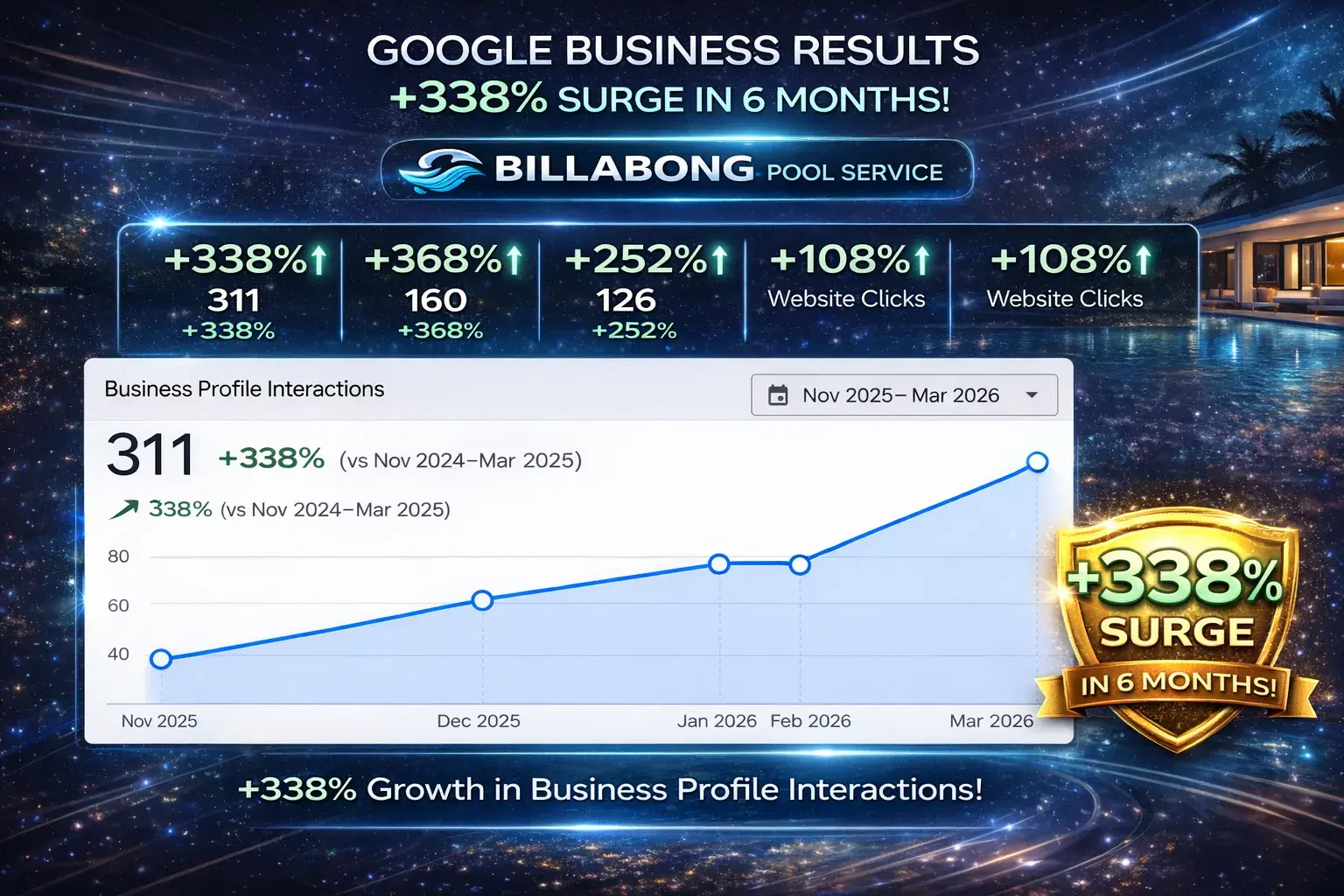
Billabong Pool Service operates from three Sunshine Coast locations. Across those three Google Business Profiles, interactions rose 338 per cent in six months. Three listings moving together answers the fear every multi-site owner carries, that lifting one branch will quietly cost another.
Each of those names the business it belongs to and says what was measured. The Billabong figure also carries the window it was measured over. The Bob Jane T-Marts figures do not: no measurement period is recorded for them, so none is claimed here. That is the test to put to every other number you get shown, including these two.
The suburb-level work carries a name of its own. Smart Local calls it GPS Local Signalling and describes it as a world first. That is the business naming its own technique. It is not a status handed down by Google, and the difference is worth being exact about, because Google sets a local result on three things, relevance, distance and prominence, with no paid route to a better one. Google also tells buyers to walk away from any provider that promises a ranking or claims a special relationship with it. So the method is pointed at what a business can genuinely change, and it is honest about the rest. What the work has produced so far is more than 6,000 keywords ranking across Smart Local's own properties and its clients'. There is no lock-in contract, so the method gets judged month by month.
Suburbs we target in Maps
- Caloundra
- Maroochydore
- Noosa
- Buderim
- Nambour
- Kawana Waters
Questions we get asked
How do I rank on Google Maps on the Sunshine Coast?
Google orders local results on three things: relevance, how well your Business Profile matches the search; distance, how far you sit from the person searching; and prominence, how well known the business is. Distance is fixed by your address. Relevance and prominence are the work, which means categories and services that match what people type, a page for each suburb you cover, listings that agree with each other, and reviews that keep arriving. Google also states there is no way to request or pay for a better local ranking.
Can an agency guarantee me the top spot on Google Maps?
No, and Google says so itself. No one can guarantee a #1 ranking, and Google warns buyers away from any SEO that guarantees rankings, alleges a special relationship with Google, or advertises a priority submit. Australian Consumer Law adds that a business must be able to prove any claim it advertises, on reasonable grounds. Smart Local has taken client businesses to the top local spot for suburb searches, and on this coast that record is Bob Jane T-Marts at Buderim. Past work, never a promise.
Why do I show up in my own suburb and nowhere else?
Distance is one of Google's three local ranking factors and it gets measured from the one address on your profile. The Sunshine Coast Council local government area covers 2,253.9 square kilometres, with density running from 2,381.6 people per square kilometre at Mooloolaba and Alexandra Headland down to 20.4 in the Caloundra Hinterland. A single pin cannot carry across that. The work is the two factors you can build, relevance and prominence, plus a page for each suburb you want to be found in. Which suburbs to add, and in what order, is covered on our Geo SEO Sunshine Coast page.
My ranking report looks fine but the phone is not ringing. What should I ask for?
Ask for what people did on the profile, not only where it sat. A position tells you the listing was showing. Interactions tell you somebody acted on it, and those are two different things to report. Billabong Pool Service is the example this page can show: Business Profile interactions rose 338 per cent across three Sunshine Coast locations in six months. If a report only ever shows positions, ask for the actions underneath them.
Do I need something extra to show up in AI results?
Google says no. There are no additional requirements to appear in AI Overviews or AI Mode, no new machine readable files, no AI text files and no special structured data, and normal SEO best practice is what applies. The results follow the same work. Morrisons Maintenance Plumbing, a Smart Local client servicing the Sunshine Coast, had AI search results rise 300 per cent in three months, with traffic and keywords up 400 per cent over six. Bob Jane T-Marts at Buderim is the Maps side of the same point, with Google profile visits up 428 per cent through AI-optimised listings.
How long does local SEO take, and am I locked in?
The client results on this page that carry a measurement window run over three and six months, which is the honest shape of it. Listing changes can move interactions inside a few months. Prominence builds slower, because reviews and directory records accumulate rather than switch on. There is no lock-in contract, so the arrangement runs month to month and you can stop at the end of any of them.
What decides how big the job is?
Two things: how many suburbs you need to be found in, and how many services you sell. A plumber covering Noosa to Caloundra and Maroochydore to Nambour, the way Morrisons Maintenance Plumbing describes its own service area, is a wider scope than a clinic working one suburb. Send the suburb list and the service list and what comes back is a scope for your business rather than a package name. Smart Local has been trading more than 20 years with no lock-in contract.
Keep exploring

Want the phones ringing?
Tell us your suburb and your trade. We'll show you exactly where the calls will come from.