
Patient enquiries from search, Maps and AI
GP practices, allied health, specialist centres. Patients pick a clinic the same way they pick anything now: they search, they compare, and increasingly they ask AI. We work to make your clinic one of the answers. SEO for clinics starts with the facts patients filter on: who the practitioners are, which services each one offers, whether you bulk bill, and how to book. This page sets out how that work is done, what it covers and the advertising rules it stays inside.


Why clinics work with us
Healthcare marketing has rules, and patients have higher stakes. We grow clinic visibility with the boring, reliable signals that work in this space: accurate listings, strong reviews, fast websites and content that answers real patient questions.
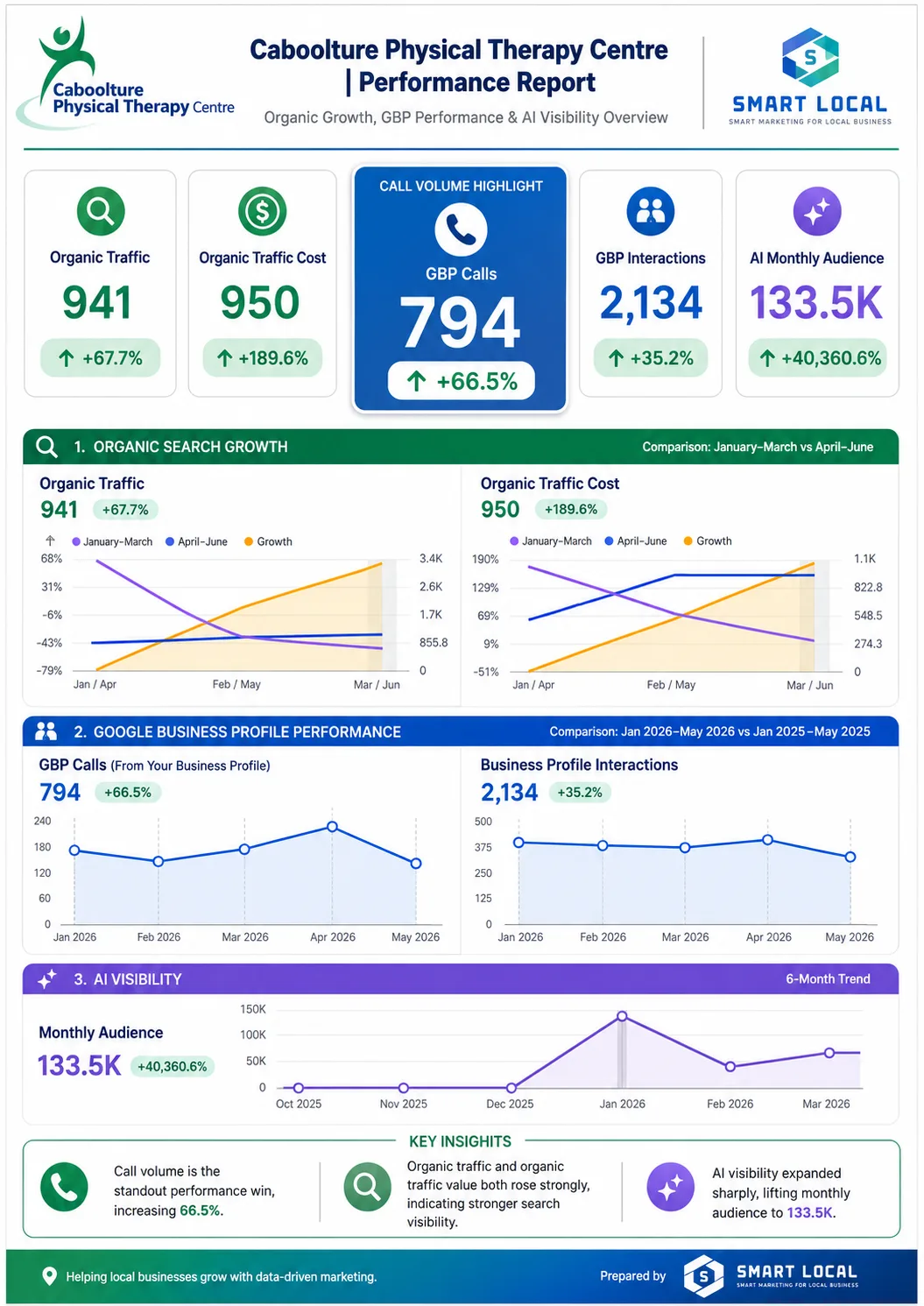
One healthcare client grew organic traffic 67.7% while calls from their Google profile rose 66.5%.
Multi-practitioner and multi-location clinics get a structure that gives every practitioner and every site its own presence, instead of one homepage trying to do all the work.
Clinic searches are full of conditions. A patient wants a female GP, a physio who sees kids, a psychologist with telehealth, an appointment this Saturday. When the listing, the website and the booking system disagree on any of those, the patient moves to the next result. So the work starts with one checked set of facts for every practitioner and service, then carries it into each place patients look.
What we run for clinics
Google Business Profiles
Accurate, optimised profiles for the clinic and each practitioner, tuned for "near me" and bulk-billing searches. Google's Business Profile guidelines let a public-facing practitioner hold a profile of their own, and where several practitioners share a location, that profile carries only the practitioner's name, not the clinic's. The work covers the primary category, hours including public holidays, booking links and the services list, checked against what the front desk actually tells patients.
Local SEO
Service and location pages built around the treatments patients actually search for. Each treatment or condition page explains what it is, who it suits, what happens at the first appointment, which practitioners provide it, and whether a referral or rebate applies, in the practice's own words. A page per service gives Google a clear match for each search, instead of one services page listing everything in a line.
AI search visibility
Structured content written for how ChatGPT and Google AI Overviews choose local health sources. In practice that means plain answers to the questions patients ask, practitioner pages with checkable facts, and the same details on your site, your profile and the booking directories. No one controls whether an AI product cites a clinic, so the work stays on the parts a clinic can control.
Review management
A compliant routine for requesting patient reviews, with monitoring and response handling. Google's review policy bars incentives for reviews and asking only the patients you expect to be happy, so the request goes to every patient at the same point, with no suggested wording. Our [review request guide](/resources/google-review-strategy/) sets out the routine. Replies stay short and never confirm a visit or a treatment.
Compliant Google Ads
Campaigns aimed at appointment searches, built inside healthcare advertising rules. [Google Ads](/services/google-ads/) can bring enquiries while organic work builds, which suits a new practitioner or a new location. Google's personalised advertising policy lists health as a sensitive interest category, so health services can't use advertiser-curated audiences such as lists built from site visitors. Campaigns rely on search terms and location instead.
Fast, accessible web pages
Pages that load fast, work on every device and make booking easy. The booking button goes to the right practitioner or appointment type in your booking system, not a generic landing page, and phone numbers are tap-to-call on mobile. Text, buttons and forms are built to be read and used with a keyboard or screen reader.
Booking and call tracking
Calls, booking-link clicks and form enquiries set up as key events in GA4, which Google describes as the actions that matter to your business. Where the booking platform allows it, those clicks are [reconciled against booked appointments](/resources/call-tracking-conversion-reconciliation/), so the report shows bookings, not just visits. No patient names or health details go into analytics.
What patients need to know before they book
Eligibility decides most clinic searches before ranking does. Someone searching "bulk billing GP near me" or "physio open Saturday" is filtering, and a listing that leaves the answer out loses to one that states it. The table sets out the questions patients filter on, where each answer has to appear and the check that keeps it right.
None of these answers is marketing copy. They're operating facts, so the practice manager signs them off, and the work keeps them in step across the booking system, the website, the profile and directories. Our guide to business listing accuracy covers the directory side.
| Patient question | Where it must be answered | Check |
|---|---|---|
| Do you bulk bill, or what are the fees? | Service pages, practitioner pages, Business Profile description | Same wording everywhere, updated the day the policy changes |
| Can I claim a Medicare, DVA, NDIS or private health rebate? | Service pages and FAQs | Written or signed off by the practice manager, never guessed |
| Are you taking new patients? | Practitioner pages, booking system | Matches the appointment types open in the booking system |
| Is telehealth available? | Service pages, Business Profile services list | Listed only for the services that offer it |
| Do I need a referral? | Treatment pages | One plain sentence per service, reviewed with the fee schedule |
| Are you open after hours or on weekends? | Business Profile hours and special hours, contact page | Public holiday hours set before each holiday |
| Who speaks my language or sees children? | Practitioner pages | Stated only with the practitioner's agreement |

Accurate practitioner facts, in a worked example
A practitioner page is the page patients, Google and AI assistants all check, so it should hold facts a patient could verify rather than adjectives. Ahpra's advertising guidelines say only practitioners with specialist registration may use specialist titles, and point to wording such as "substantial experience in" for everyone else. The fact set below follows that rule.
Say a physiotherapy and podiatry practice in Maroochydore has four practitioners (an illustrative setup, not a client). Two physios work weekdays, a podiatrist is in on Tuesdays and Thursdays, and a fourth physio works Saturdays only. The website has one team page with four short bios that say "passionate about helping patients", and the Business Profile shows weekday hours only. A patient searching for a Saturday physio never finds the fourth practitioner.
Once the fact set is filled in, each practitioner has a page with their days, the services they provide and a booking link to their own appointment types. The clinic profile shows Saturday hours. The Saturday physio, who sees patients directly at the clinic, can hold a profile of their own under Google's practitioner guidelines, named for the practitioner only. Nothing on these pages claims a result. They answer the questions a patient would otherwise ring the front desk to ask.
- Registered professionAs it appears on the Ahpra public register, so a patient can check it.
- Areas of interestDescribed as experience or interest, never as a specialty unless the practitioner holds specialist registration.
- Days and locationsWhich sites, which days, kept in step with the roster.
- Languages and patient groupsOnly what the practitioner confirms, such as children, older patients or sports injuries.
- BookingA direct link to that practitioner's appointment types.
- Fees and rebatesBulk billing or private fees in the practice's own words.
- Author and reviewerWho wrote and who checked the page. Google's guidance on helpful content asks whether it's clear who created a page and says trust matters most.
How Google picks which clinics to show, and why yours may be missing
Google's Business Profile Help names three local ranking factors: relevance, meaning how well a profile matches the search; distance, meaning how far the business is from the searcher; and prominence, meaning how well-known it is, which reviews and ratings feed. The same page says there's no way to request or pay for a better local ranking. Your address fixes distance. Relevance and prominence are where the work happens.
When a clinic is missing from Maps or from the organic results, the cause is usually one of the problems below, and an audit checks each in turn. Our Business Profile checklist lists the profile checks in full.
- Wrong primary categoryA physiotherapy clinic filed under a broad health category can miss the specific searches patients type.
- Practitioner profiles competing with the clinicA practitioner profile carrying the clinic's name, which Google's guidelines rule out where several practitioners share a location.
- Thin service pagesOne services page naming every treatment in a line, so no page is a strong match for any single search.
- Details that disagreeDifferent hours or phone numbers across the website, the profile, booking directories such as HotDoc or HealthEngine, and old listings.
- Little review activityGoogle ties prominence to reviews and ratings, so a profile with few recent reviews has less to show.
- Stale hours and broken booking linksA patient who rings outside the listed hours, or lands on a dead booking page, leaves before the clinic knows they came.

The advertising rules clinic marketing has to follow
Advertising a regulated health service in Australia falls under section 133 of the Health Practitioner Regulation National Law, and Ahpra's advertising guidelines explain how it applies. The rules cover the clinic's website, profiles, ads and social posts, so they shape the work from the first draft. The table sets out the main ones and what changes because of each.
Ahpra's guidelines also say practitioners aren't responsible for reviews on sites they don't control, such as Google. Republishing clinical comments from those reviews in the clinic's own advertising, including its website, is a different matter, so review widgets that pull treatment comments onto the site are left out. The practitioner carries these obligations, so a practitioner or the practice manager approves the final copy before anything goes live.
| Rule | Where it comes from | What changes in the work |
|---|---|---|
| No false, misleading or deceptive claims | National Law s133 | Every claim about a service or practitioner is checked against what the clinic can show |
| No testimonials about clinical aspects of care | National Law s133 and Ahpra's guidelines | No patient stories about treatment results; comments about customer service or communication with no clinical reference aren't testimonials under the guidelines |
| No unreasonable expectation of beneficial treatment | National Law s133 | Service pages describe what happens at an appointment, not what it will achieve |
| No encouraging indiscriminate or unnecessary use of services | National Law s133 | No urgency messaging pushing people to book treatment they may not need |
| Gifts, discounts or inducements must state their terms and conditions | National Law s133 | A new-patient offer runs with its full terms, or not at all |
| Specialist titles only with specialist registration | Ahpra's guidelines | Practitioner pages use experience wording unless the register shows specialist registration |
| No incentives for reviews and no asking only happy patients | Google's review policy | One review request to every patient, with nothing offered |
| Health is a sensitive interest category | Google Ads personalised advertising policy | No advertiser-curated audiences for health service campaigns |
How the work changes by clinic type
Different clinics get searched for different reasons, so the plan changes with them. The same checks run for every clinic; the order and the weight shift.
For every type, success is counted in calls and bookings. The report shows profile calls, booking-link clicks and form enquiries, compared with the clinic's own appointment numbers where it shares them. Visibility figures sit underneath as context, never as the result.
| Clinic type | What patients filter on | Where the work starts |
|---|---|---|
| GP practice | Bulk billing, new patients, same-day and after-hours appointments, practitioner gender and languages | Clinic and practitioner profiles, hours, and practitioner pages with days on site |
| Allied health (physio, chiro, podiatry, psychology) | The condition or treatment, weekend times, rebates, telehealth for some services | A page per treatment or condition, with booking links per appointment type |
| Specialist rooms | Referral requirements, the specialist's registration and areas of practice, location | Accurate specialist pages and clear referral information for GPs and patients |
| Multi-site groups | The nearest site and which practitioners work where | One page and one profile per site, all fed from a single fact set |
How patients choose a clinic
Patients search "GP near me", "physio open Saturday" or a specific treatment, then judge in seconds: rating, distance, whether they can book easily. Each of those is a signal we can improve.
Some patients now ask AI assistants for recommendations before they open Maps. Those answers draw on what's published about a clinic, so the same checked facts on the website, the profile and the booking directories give an assistant less to get wrong.
The choice usually comes down to one practical question: can I see the right person, soon, on terms that suit me? A clinic that answers it in the listing, on the practitioner page and in the booking system makes the decision easy. One that leaves it to a phone call loses the patients who search after hours.
Questions we get asked
Is your healthcare marketing compliant?
Smart Local writes clinic campaigns and content to Australian healthcare advertising rules: no promised outcomes, no misleading claims, and careful handling of testimonials. Google Ads campaigns are aimed at appointment searches and built inside those rules, and patient reviews are requested through a compliant routine with monitoring and response handling.
Can you handle multiple practitioners and locations?
Yes, Smart Local handles clinics with multiple practitioners and locations. Each location and practitioner gets its own optimised presence under one strategy, so they support each other instead of competing for the same searches. That structure replaces one homepage trying to do all the work, and it includes accurate Google Business Profiles for the clinic and each practitioner, tuned for "near me" and bulk-billing searches.
How do patients actually find us through AI?
Patients find your clinic through AI when assistants pull from structured, consistent information about it across the web. That means your site, your Business Profile and directories such as HotDoc or HealthEngine should state the same practitioners, services and hours. We build and maintain those signals so your clinic is a clear candidate for AI answers, though no one can guarantee an assistant names a particular clinic.
What are the most effective SEO strategies for doctors?
The strategies that work for doctors start with accurate facts, not volume. Set the right primary category, keep clinic and practitioner profiles consistent, give each service its own page, and state bulk billing, new-patient and referral details plainly. Then ask every patient for a review the same way and track calls and bookings. All of it stays inside Ahpra's advertising guidelines, which rule out testimonials about clinical care.
How much does SEO typically cost for a clinic in Australia?
Clinic SEO cost follows scope, and scope comes from things you can count: the number of locations, how many practitioners need their own profiles and pages, how many services need pages, how competitive your suburbs are, and whether Google Ads runs alongside. Ask any agency to show how its quote maps to those numbers. A quote that can't be traced back to the work is hard to judge.
How do you attract more patients to your clinic?
Patients choose the clinic that answers their questions fastest. Show your hours, bulk billing or fee details, new-patient availability and a direct booking link on your Business Profile and your site. Give each practitioner a page with real facts. Ask every patient for a review in the same way, with no incentive. And make booking work on a phone, after hours, without a call.
How should a clinic reply to a patient's Google review?
Reply briefly, thank the person, and don't confirm they're a patient or mention any treatment. Ahpra's social media guidance warns that small details can add up to identify a patient. For a complaint, give the practice manager's contact and take it offline. Never offer anything in exchange for changing or removing a review, which Google's review policy prohibits.
How long before a clinic sees results from SEO?
It depends on where the clinic starts and how crowded its area is, so no fixed timeline holds. Fixes such as the right category, correct hours and working booking links count once Google updates the profile. New service and practitioner pages take longer to be crawled and ranked. We report profile calls, booking enquiries and search visibility, and you can check each one in your own reporting.
Keep exploring

Want the phones ringing?
Tell us your suburb and your trade. We'll show you which searches and suburbs we'd target first.