
Pest control marketing with the numbers to prove it
Our strongest client results come from pest control. Termite inspections, infestations and recurring treatments all start as local searches, and those local searches are what our work targets. Below is how SEO for pest control works in practice: site structure, termite pages, commercial buyers and honest measurement.


Why pest control suits this system
Pest control demand comes in waves. Warm months bring the treatment searches, and termite worries spike around property purchases. When an infestation hits, it's as urgent as any burst pipe.
That mix of urgent jobs and planned inspections is exactly what our system is built for. Maps and call ads catch the urgent work. Suburb pages and content catch the inspection and prevention searches that build a recurring book.
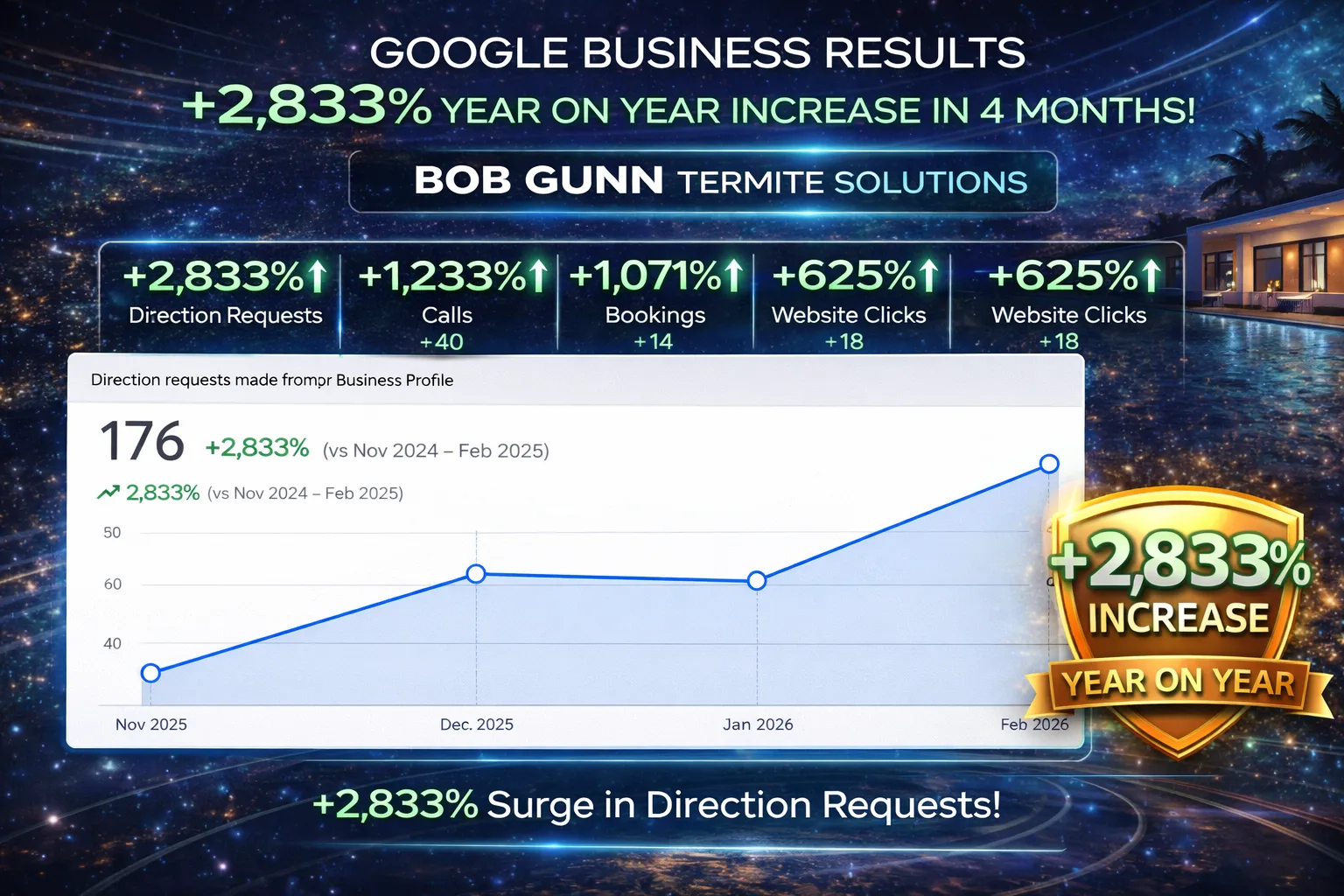
Bob Gunn Termite Solutions is the proof. Directions to their business grew 2,833% and calls grew 1,233% in four months. Those are the strongest numbers we've produced for any client, and they came from Google Business Profile work, the Maps part of this playbook.
What we run for pest control businesses
Google Business Profile
Tuned for the searches behind urgent treatments and termite inspections, with the reviews and photos that win the click. Google says local results rest on relevance, distance and prominence, and that there's no way to request or pay for a better local ranking. So the work is accuracy: the most specific primary category that fits, services listed by pest and treatment, current hours and phone, and a hidden street address if you only visit customers, as Google's guidelines ask of service-area businesses.
Suburb landing pages
Pages for the suburbs you genuinely treat, because pest searches often carry a location. Each one carries something only true of that area: the housing types your technicians see, the jobs you've done there, how quickly you can reach it. Suburbs with nothing real to say are listed on a service area page instead.
Google Ads in peak season
Budgets that ramp with the season, so your ads run hardest when the summer surge arrives. Underneath that sit call assets scheduled to the hours someone can answer, negative keywords that screen out do-it-yourself searches, and conversions counted against booked jobs, so the account learns from bookings.
Review growth
Homeowners letting a stranger treat their house read reviews closely. We keep yours fresh and detailed. Requests go to every completed job: Google's review policy bars selectively asking happy customers and offering incentives for reviews, and the ACCC says it's against the law for a business to create fake or misleading reviews.
AI search visibility
When someone asks an AI tool who handles termites in their area, the answer draws on what the web says about local businesses. Google says a page must be indexed and eligible for a snippet to appear as a supporting link in AI Overviews or AI Mode, with no special markup required. The work is clear service pages and consistent business facts across listings. No one can guarantee an AI product will cite a particular business.
Call tracking
Treatment calls and inspection bookings tracked by source and suburb, so you can see what drives the book. In Google Ads, call reporting counts calls as conversions through Google forwarding numbers. Calls from the Business Profile show in its performance data, and website enquiries are tagged by page, so each booked job can be traced back to where it started.
Licences and standards on the page
Pest buyers check who's allowed in their house. In Queensland, a pest management licence administered by Queensland Health is needed to apply pesticides or fumigants commercially, with endorsements such as timber pest control. Your licence numbers and endorsements go on every service page and match your profile and invoices. Standards your reports follow are named only once your team confirms them.

Structure the site around pests, services and suburbs
Pest searches split by pest, by service and by place, and each split carries its own urgency. Someone typing "rats in the roof" late at night wants a callback. Someone typing "pre-purchase termite inspection" has a settlement date. One general pest control page can't answer both, so the site gets a page for each main pest and treatment, and suburb pages only where demand and real local detail exist.
The table is a typical starting map for a general pest and termite business. Your own service list and Search Console data decide the final version.
Suburb pages are where most pest sites go wrong. Google's spam policies describe doorway abuse as pages created to rank for specific, similar search queries, and give pages targeted at specific regions or cities that funnel users to one page as an example. Twenty copies of one text with the suburb swapped is that pattern. A suburb earns its own page when there's search demand for it and something true only of that area to say; otherwise it's listed on a service area page. The guide on when local landing pages deserve indexing sets out the test in full.
| Page | What the searcher usually wants | What the page needs |
|---|---|---|
| Termite inspection | A booked inspection, often before a purchase or after spotting damage | What's inspected, the report they receive, licence details, how soon you can attend |
| Termite treatment and management systems | A plan once termites are found, usually a bigger decision | Chemical, baiting and physical options in plain terms, how treatment follows the inspection, how ongoing checks work |
| General pest treatment | Cockroaches, ants and spiders handled at home | What's treated inside and out, preparation steps, precautions for pets and children, the re-treatment terms you actually offer |
| Rodents | Quick help with noises or droppings in the roof or kitchen | A visible phone number, how entry points are found and sealed, follow-up visits |
| Commercial pest management | A schedule and records for a food business, strata or property manager | Visit frequency, reporting, the premises types your licence endorsements cover |
| Suburb pages | Someone nearby who can come this week | Local detail only you would know, links to the relevant service pages, the same name, address and phone as your profile |

Termite work is its own buying decision
Termite enquiries behave differently to general pest calls. The searcher is often a buyer with a contract deadline, or a homeowner who's found mud tracks or soft timber and is worried about what comes next. They compare more, read more and ask about the report before they book. And the inspection leads into the bigger decisions: treatment, a management system, ongoing checks.
The pages for this work should answer a careful buyer's questions in the language they may already have read. The QBCC advises Queensland homeowners to have a licensed pest controller inspect and report on their property every year, or more often in high hazard areas, and to keep a durable termite management notice, usually in the meter box. Standards Australia publishes AS 3660.2 for termite management in and around existing buildings, and AS 4349.3 covers timber pest inspections. If your reports follow those standards, say so plainly.
Licensing belongs on these pages too. The QBCC's termite management (chemical) licence covers pre-slab and perimeter treatment of new buildings and inspections of completed buildings, and it requires the Queensland Health pest management licence as well. Other states license this work differently, so pages for businesses outside Queensland name the local regulator instead. A termite inspection page should show:
- What's inspectedThe areas and timbers checked, and what can limit access, such as stored goods, wall linings or a tight roof void.
- The reportWhat the customer receives, when it arrives, and the standard it follows once your team confirms one.
- Pre-purchase timingHow you handle settlement deadlines, stated only as lead times you can actually meet.
- What happens after a findingHow a treatment proposal follows the inspection, explained without pressure.
- LicencesLicence numbers and endorsements, matching your Business Profile and invoices.
- One booking pathA tracked phone number and a short form, both visible on a phone screen.
Commercial and recurring contracts need different proof
Commercial buyers search differently from homeowners. A cafe owner, a strata manager or a property manager wants a service schedule, records they can show an inspector or an owner, and evidence that you're allowed to work in their kind of premises. Food Standards Australia New Zealand says Standard 3.2.2 requires food businesses to make sure pests are stopped from entering or living in their premises, so a cafe owner is buying routine visits and documentation as much as a treatment.
Queensland's pest management licence has separate endorsements for sensitive places, such as aged care and childcare, and high-risk places, such as food manufacturing. A commercial page should state which endorsements your technicians hold, the premises types you service, what a routine visit includes and how reports are delivered. Recurring residential plans follow the same logic: name what the plan covers and how often visits happen, using only terms you actually offer.
Property managers are a distinct audience. They book on behalf of owners and tenants, often across several suburbs and against end-of-lease dates, and care about access arrangements and invoicing. A short page for them, linked from the commercial page, answers questions before the call. The pest control lead qualification guide covers how to sort these enquiries once they arrive.
What each channel does, and when to expect data
Pest control marketing usually runs on three or four channels at once, and each moves on a different clock. No one can promise when, or whether, rankings or calls will move, so the table describes what each channel does and the first signs worth watching. These are typical patterns, not targets.
Seasonal pages go live before the season, not during it. New pages take time to be crawled and settle, so warm-month treatment pages should be published and linked well ahead of the rise. The QBCC has warned that wet weather and moisture, combined with north Queensland's high humidity, help termites flourish, which is one reason to review termite pages before each summer. Your own Search Console data, filtered by query and page, shows when your enquiries actually climb; the guide to local SEO seasonality explains how to read it.
- Call assets on a scheduleGoogle Ads lets you schedule a call asset to show only on the days and hours your business can take calls, so late-night searchers aren't sent to voicemail.
- Negative keywordsSearches like "how to get rid of ants yourself" come from people planning a do-it-yourself job. Negative keywords exclude those search terms from your campaigns.
- Ad schedule and seasonal budgetsAd scheduling sets the days and hours ads show and adjusts bids by time. Budgets lift ahead of the warm months and ease back after.
- Location targeting by service areaAds target the suburbs your technicians can reach in a working day and exclude areas you'd turn down.
- Conversions that mean a jobCall reporting counts calls from ads as conversions. Those calls are then matched to booked jobs, so bidding learns from bookings rather than every ring.
| Channel | What it does for pest control | First signs to watch | How it's measured |
|---|---|---|---|
| Google Ads | Reaches urgent searches as soon as campaigns are live | Search terms, clicks and calls in the first weeks, which show whether targeting is right | Calls and forms counted as conversions, then matched to booked jobs |
| Business Profile and Maps | Competes for map results on searches near the customer | Profile views, calls, direction requests and website clicks in the profile's performance data | Monthly calls and actions, compared with the same months a year earlier |
| Organic pages | Builds visibility for pest, treatment and suburb searches over time | Impressions for new pages in Search Console before clicks follow | Clicks, queries and pages in Search Console, plus enquiries from each page |
| AI answers | Draws on indexed pages and listings when someone asks an AI tool | Whether your business appears when you test your customers' own questions | Referral visits in analytics where the tool passes them, read with each tool's reporting limits |
A hypothetical example: the first 90 days for a two-van business
Say a pest control business with two vans in Caloundra wants more termite inspections and steadier winter work. This is a made-up example to show the order of the work. It isn't a client, and the timings are illustrative.
By week 12 the owner would usually have cleaner data than before: which channel produced which bookings, and which new pages have started collecting impressions. Whether rankings have moved by then depends on competition, the starting point and the area. That's why the review compares against the business's own baseline rather than a promised number, and why how long local SEO takes is answered with a range and the reasons behind it.
- Weeks 1 and 2: auditCheck the Business Profile against Google's guidelines, crawl the website, pull twelve months of Search Console data and list where calls come from today.
- Weeks 2 and 3: map visibility checkSearch the main pest terms from points across the whole service area, well beyond the depot, to see where the profile appears and where it drops away.
- Weeks 3 to 6: page plan and buildWrite or rebuild the termite inspection, termite management, general pest, rodent and commercial pages, and add suburb pages only for the few areas with demand and real local detail.
- Weeks 4 to 6: trackingTurn on call reporting in Google Ads, tag website enquiries by page, and add a simple booked or not booked marker in the job system.
- Weeks 6 to 12: ads and reviewsRun inspection-focused campaigns with do-it-yourself negatives, and send a review request after every completed job.
- Week 12: first reviewCompare enquiries, booked jobs and Search Console impressions against the baseline, then decide what changes next.

How locals search for pest control
Pest searches are local and specific. A pest plus a suburb, or a termite inspection plus "near me". The searcher usually wants someone this week.
Property transactions drive a steady undercurrent of inspection searches all year, while summer multiplies the treatment ones.
We work on your visibility across every suburb in your run, for the seasonal surge and for the off-season inspection searches.
Renters, landlords and property managers search too, often against an end-of-lease date. A short page on how you handle end-of-lease treatments, and who usually books them, catches searches that a general pest page misses.
Questions we get asked
What is SEO for pest control?
SEO for pest control is the work of making a pest business show up when people nearby search for a pest, a treatment or an inspection. It covers the Google Business Profile behind the Maps results, a page for each main pest and treatment, suburb pages where demand is real, reviews, and the technical health of the site. Local SEO is the part tied to place; general SEO is the site and content underneath it.
Can you smooth out the seasonal dips?
Smart Local works on the seasonal dips by targeting inspections, prevention work and recurring treatment plans through the cooler months. Property transactions drive a steady undercurrent of inspection searches all year, and suburb pages and content catch those searches to build a recurring book. We then concentrate ad spend into the summer peaks, when the treatment searches flood in.
Termite inspections are my main earner. Can you focus there?
Yes, Smart Local can focus your marketing on termite inspections. Inspection demand behaves differently to treatment demand: property transactions drive inspection searches all year, while summer multiplies the treatment ones. So we build separate pages and campaigns for inspections, including the searches tied to property purchases, and track inspection bookings by source and suburb so you can see what drives them.
How much does SEO typically cost in Australia?
There's no single figure, because cost follows the amount of work. The main drivers are how many suburbs and pests you want covered, how competitive those searches are, whether the website needs rebuilding, and whether Google Ads spend sits on top. A two-van business in a handful of suburbs needs less work than a multi-region operator. Ask any agency to scope the work before quoting, then use the guide to comparing marketing proposals to weigh them.
Which advertising works for pest control services?
For urgent jobs, Google Ads and the Maps results usually matter most, because people with rats or a wasp nest tend to search and call the same day. For termite inspections and recurring plans, service pages and reviews carry more weight, because buyers compare before booking. Most pest businesses run both: ads for immediate calls, SEO and the Business Profile for demand that builds. Judge each by booked jobs before moving budget between them.
Is SEO still worth it in 2026?
For most pest businesses, yes, as long as it's judged on booked jobs. People still search Google for pests and inspections, and Google says a page must be indexed and eligible for a snippet in Search to appear as a supporting link in AI Overviews, so the same pages serve both. Some answers now resolve without a click, so watch impressions and calls alongside website visits.
Will I be locked into a contract?
No, you won't be locked into a contract with Smart Local. We run a no lock-in policy across every industry we serve and work on a month-to-month basis. The results have to keep you, because a contract won't. You can watch your own numbers in live reporting, with treatment calls and inspection bookings tracked by source and suburb, so you can see what drives the book.
Keep exploring

Want the phones ringing?
Tell us your suburb and your trade. We'll show you which searches and suburbs we'd target first.