
Answer Engine Optimisation for featured snippets and AI assistants
A featured snippet or a voice assistant's reply gives one answer, and ChatGPT names a short list of businesses. Answer engine optimisation (AEO) is the work of getting your business into those answers, in featured snippets, answer boxes and AI assistants.


Why choose us for AEO
Some answer engines give one answer: the snippet at the top of Google, the answer box, the name a voice assistant reads out. AI assistants name a short list, often two or three businesses. The work aims at those few spots.
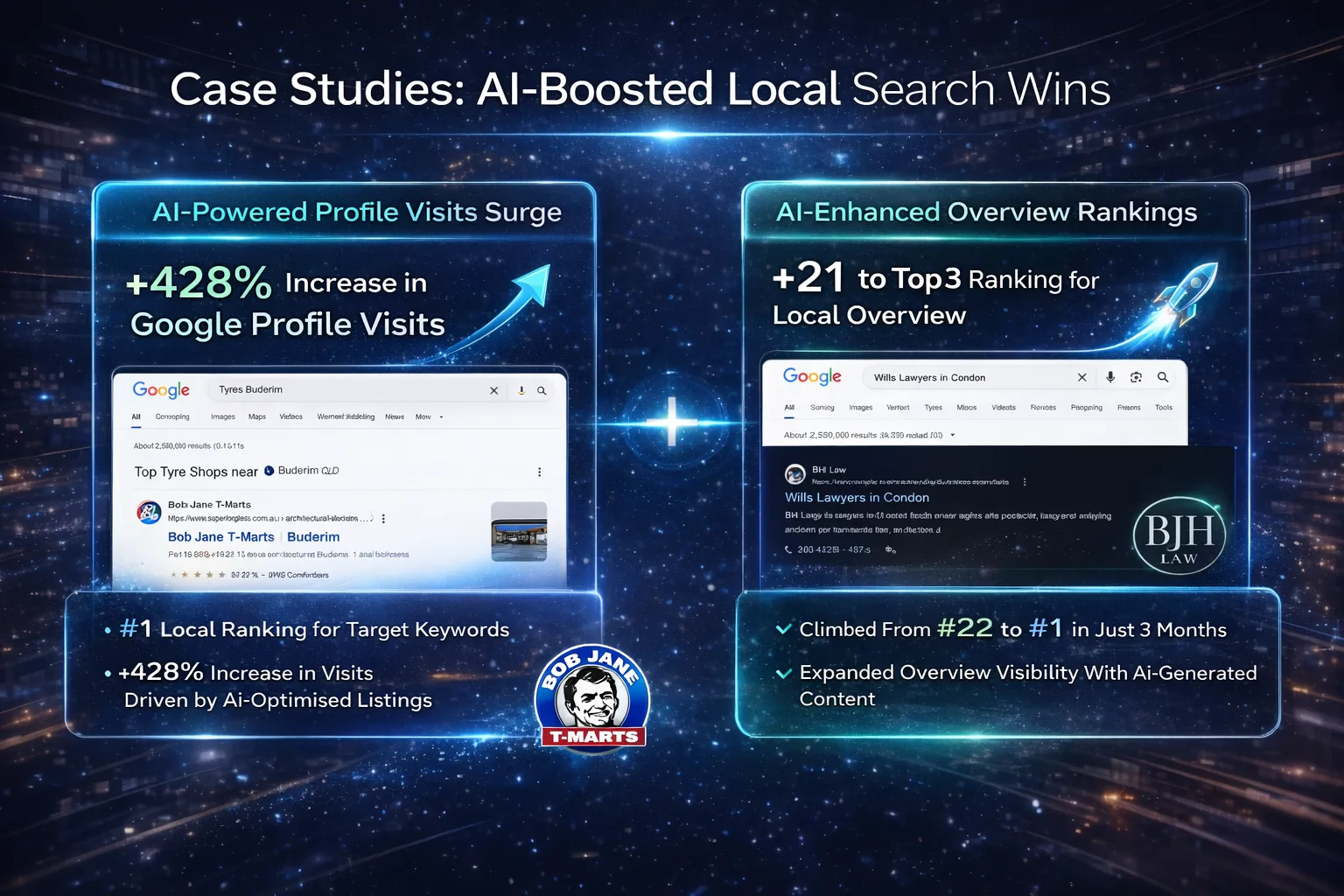
We do this work for paying clients now. A Buderim tyre store we manage grew its Google profile visits by 428% through AI-optimised listings.
AEO runs beside your SEO and generative engine optimisation (GEO) work, since the same clean structure that wins a snippet also helps AI tools cite you. Nothing gets built twice.
We're also straight about the limits. Google's own guide to its generative AI features says there are no special requirements or AI-only files needed to appear in AI Overviews or AI Mode, and that pages don't need to be chopped into chunks. So the work is clear pages for people, accurate business facts and access for the crawlers.
You see the questions we target, the answers you hold and what we're changing next month. Plain reports, no jargon.
What's included
Question research
We find the exact questions your customers ask Google, ChatGPT and voice assistants, then rank them by buying intent. Sources include your Search Console queries, People Also Ask boxes, the questions your staff hear on the phone and what AI tools say when we put those questions to them. Each question is tied to the one page that should answer it.
Direct answer content
Short, plain answers placed high on the page, under a heading that asks the question the way people say it out loud. The answer comes first in two or three sentences, then the detail, conditions and exceptions follow. That shape suits a featured snippet, a spoken reply and a reader on a phone at the same time.
Structured data that matches the page
Organisation or LocalBusiness markup with your real name, address, phone, hours and profile links, plus Service markup where it fits. Google's structured data guidelines say markup must describe content people can see on the page, so every value is checked against the visible text. FAQ markup no longer earns a rich result in Google, so it's treated as optional.
Consistent business identity
An answer engine has to know whose answer it is before it can name or link you. We line up your business name, phone, address, service list and service area across your site, [your listings](/resources/business-listing-accuracy/) and social profiles, and connect them with sameAs links in your markup.
Google Business Profile answers
Your profile's services, posts, description and review replies written to answer the questions locals ask near you.
Crawler access and readable answers
We check that answers sit in the page's HTML, not behind a tab that only loads after a click or inside a pop-up, and that robots.txt lets Googlebot, Bingbot, OpenAI's OAI-SearchBot and PerplexityBot fetch the pages. A blocked crawler or a broken render rules a page out before content is even judged.
Answer tracking
We watch which snippets, answer boxes and AI citations you hold, and rework anything that slips. The same fixed question list gets checked each month, so changes show up against a baseline instead of a hunch.
How an AEO engagement runs, step by step
An engagement starts with measurement and only then changes pages. Month one is mostly research and fixing what stops engines reading you; later months add answers, corroboration and refreshes. The order below matters, because a rewritten answer on a page a crawler can't fetch does nothing.
- Build the question mapList the questions that lead to paid work, across every service and suburb you want more of. Group them by service and suburb, mark which ones carry buying intent, and assign each to a single page so two pages never compete for one answer.
- Record the current answersPut each question to Google, ChatGPT, Perplexity and Copilot and note who gets the snippet, who gets named and which pages get linked. This baseline, with dates and screenshots, is what every later report is compared against.
- Fix access and renderingCheck robots.txt, indexing, page speed and whether each answer appears in the HTML a crawler receives. These fixes come first because they gate everything else.
- Restructure the answer pagesRewrite the top of each assigned page into a question heading, a direct answer and supporting detail, using your own service area, conditions and policies as the facts. Thin or duplicate pages get merged rather than multiplied.
- Mark up and align your factsAdd or correct structured data, then make your Business Profile, directory listings and social profiles say the same thing as the page.
- Track, refresh and reportRe-run the question list monthly, refresh answers when your services or the facts change, and report what moved, what didn't and what's next.

AEO, SEO and GEO side by side
The three overlap, and the differences are about where the answer shows up and how success is counted. AEO depends on SEO: Google's documentation says snippets are created primarily from the page content itself, and a page has to be indexed and eligible for a snippet before it can appear in AI Overviews or AI Mode. Our generative engine optimisation page covers the longer AI-written responses in more depth.
| SEO | AEO | GEO | |
|---|---|---|---|
| Main goal | Rank pages in the organic results | Be the direct answer, or one of the few named | Be mentioned and cited inside longer AI-written responses |
| Where it shows | Blue links and the Maps pack | Featured snippets, People Also Ask, AI Overviews, voice replies, assistant shortlists | ChatGPT, Gemini, Perplexity and Copilot responses, AI Mode |
| Content shape | Full pages built around a topic and its keywords | Question headings with a short answer first, detail after | Clear facts and evidence that a model can summarise and attribute |
| What gets counted | Rankings, clicks, calls and forms | Snippets held, appearances in AI answers, linked citations | Mentions, citations and referral visits from AI tools |
Worked example: one Maroochydore question, before and after
Say a plumbing business in Maroochydore wants to be the answer to "can you replace a hot water system the same day in Maroochydore?" This is a hypothetical illustration, not a client, and the details are made up to show the structure.
Before, the answer exists but no engine can use it. It sits in the fourth paragraph of a general services page, inside a tab that loads by script, and the Business Profile lists a different set of suburbs from the website. An engine has nothing short to quote and two conflicting sources about where the business works.
After, the services page gets an H2 that asks the question, followed by a two-sentence answer: yes, on most weekdays when the replacement unit is in stock, with the cut-off time and the suburbs covered. A short list then covers what can delay a same-day job, such as access or a gas changeover. The page's LocalBusiness markup, the Business Profile services and description, and the directory listings all carry the same name, phone and service area. Nothing here promises the snippet; it removes the reasons an engine would pass the page over. For trade-specific strategy beyond this one question, see our page on SEO for plumbers.
| Element | Before | After |
|---|---|---|
| Heading | "Our services" | "Can you replace a hot water system the same day in Maroochydore?" |
| Answer position | Fourth paragraph, inside a script-loaded tab | First two sentences under the heading, in the HTML |
| Answer content | "We pride ourselves on fast service" | Yes or no, the conditions, the cut-off time and the suburbs |
| Supporting detail | None | A short list of what can delay a same-day job |
| Business facts | Website and profile list different suburbs | Site, markup, profile and listings match |
How AEO results are measured honestly
Each answer engine reports differently, and some report nothing, so the measures are kept separate instead of blended into one score. Search Console's Generative AI performance report counts impressions when links to your site are shown in AI Overviews and AI Mode. Google says the report has been available to all sites since 31 August 2026, but a site with too few impressions in AI features may not see data. Bing Webmaster Tools' AI Performance report, in public preview, shows citations across Copilot and Bing's AI summaries, along with the grounding queries behind them. Our guides on Google AI impressions and measuring ChatGPT referrals cover the setup.
A visit to a page by an AI crawler is not proof of a citation, and a mention without a link sends no traffic. Our guide on why a crawl does not prove an AI citation explains the difference. Calls and forms remain the measure that pays the bills, so every report ends there.
| Measure | Where it comes from | What it can't tell you |
|---|---|---|
| Featured snippets and People Also Ask held | Monthly checks of the fixed question list, with dated screenshots | What another person in another suburb sees at another time |
| AI Overviews and AI Mode impressions | Search Console Generative AI performance report, where available | Which words the AI used about you |
| Copilot and Bing AI citations | Bing Webmaster Tools AI Performance report | Anything about ChatGPT, Gemini or Perplexity |
| Named or linked in ChatGPT, Perplexity and Gemini | Manual runs of the same questions, logged each month | A share of all answers; responses vary between runs |
| Visits, calls and forms from answer surfaces | GA4 referral sources and call tracking | Zero-click answers where someone read your name and called later |
Which answer engines the work covers, and who it suits
The work covers Google's featured snippets, People Also Ask, AI Overviews and AI Mode, plus ChatGPT search, Perplexity, Gemini, Microsoft Copilot and the spoken replies from voice assistants. Each one decides for itself what to show. Google's featured snippet documentation says plainly that its systems determine whether a page would make a good featured snippet, so the job is making your page the clearest candidate. For Google's AI features in particular, see how AI Overviews and AI Mode work.
Off-site agreement matters too. Google's Business Profile Help says local results rest mainly on relevance, distance and prominence, and that there's no way to pay for a better local ranking. Google's AI guide also notes that seeking inauthentic mentions across the web isn't as helpful as it might seem. So the off-site work is accurate listings and genuine reviews. If your Business Profile is unverified or your phone number differs between listings, fix those basics first; AEO builds on them.
AEO is worth prioritising when any of these sound familiar:
- Competitors get named when you ask an AI tool about your trade in your suburb, and you don't.
- Your rankings look steady in Search Console but clicks on question-style searches are falling.
- You don't know what ChatGPT or Google's AI says about your services, hours or service area, or it gets them wrong.
- Customers keep ringing with the same questions your website should already answer.
Built for your local market
Take a local question. "Who fixes hot water systems in Maroochydore" gets one spoken answer, and the business behind it gets the call.
We write suburb-level answers tied to your real service area, so answer engines match you with the right locals instead of a vague region.
On the Sunshine Coast, question research starts with your trade and the suburbs you work in.
Questions we get asked
What does answer engine optimisation do?
Answer engine optimisation makes your pages and business facts easy for search engines and AI tools to quote, attribute and link. In practice that means finding the questions customers ask, answering each one clearly near the top of a page, keeping your name, phone and service area identical everywhere, and letting the crawlers read your pages. It improves your chances of being the answer; it can't force an engine to pick you.
What is AEO vs SEO?
SEO earns a page a place in the search results; AEO shapes that page so its answer can be lifted straight into a snippet, a voice reply or an AI response. They aren't alternatives. Google only builds snippets and AI Overview links from pages it has indexed, so AEO work on a page with weak SEO has little to stand on. Most engagements fix the SEO gaps first.
Is AEO real?
Yes, AEO is real in the sense that answer surfaces exist and pull from web pages, but it isn't a separate secret system. Google says its AI features need no special markup, AI text files or chunked content. What does make a difference is ordinary, checkable work: clear answers, accurate facts, crawlable pages and consistent listings. Be wary of anyone selling AEO as a hidden trick.
Is SEO dead now with AI?
No, SEO isn't dead, because AI answers still draw on web pages that search engines have crawled and indexed. Google's guidance on generative AI features says the same SEO practices still apply. What has changed is how people see results: more questions now get a summary before the links, which makes clear answers and accurate business details more important than they were.
Can anyone guarantee a featured snippet or a mention in an AI answer?
No one can guarantee a featured snippet, an AI Overview link or a ChatGPT mention. Google states that its systems decide which page makes a good snippet, and that structured data enables a feature without guaranteeing it. AI tools also give different answers from one run to the next. An honest agency promises the work and the reporting, never the placement.
How long does AEO take to show results?
There's no fixed timeline. Access and markup fixes can be picked up once engines recrawl the affected pages, and Search Console's URL Inspection shows when Google last crawled a page. Snippets and AI citations depend on competition for each question and on how often each engine refreshes, so some questions move within a few months and others take longer or don't move.
Does FAQ schema still help with answer engines?
FAQ schema no longer earns a rich result in Google, which stopped showing FAQ rich results in May 2026. Google also says no special schema is needed for its AI features. The questions and answers themselves still help readers and engines when they're visible on the page, so we keep well-written FAQ sections and treat the markup as optional.
Keep exploring

Want the phones ringing?
Tell us your suburb and your trade. We'll show you which searches and suburbs we'd target first.