
Marketing for landscapers that evens out the seasons
Spring fills a landscaper's phone and winter goes quiet. Search visibility takes months to build, so we build it through the quiet stretch and your pages are in place before the season turns. SEO for landscapers also has to serve two kinds of work at once: design and construction projects that homeowners research for weeks, and maintenance rounds booked on availability. This page sets out how we plan for both.


Why landscapers work with us
Landscaping demand swings with the weather. Garden makeovers surge when it warms up, and the landscapers ranking first in spring built that visibility through winter.
Winter work exists too. Retaining walls, drainage, structural landscaping and design jobs run year round, and we keep those pages earning while the garden makeover searches sleep.
We run the same local system for outdoor trades already, and the results are published. Search, Maps, reviews and AI answers, wired together so each one feeds the next.
No lock-in contracts, and your enquiry numbers sit in live reporting you can open any day of the year.
What we run for landscapers
Seasonal search planning
We time content and page launches ahead of the booking season so your pages have time to build. In practice that means a plan agreed in autumn: which service pages get written or rebuilt first, which project pages follow, and which profile updates land before September.
Pages for design and structural work
Garden design, retaining walls, turf, paving and irrigation each get a page matched to the searches behind it. Each page says what the job involves, which site conditions change the scope, what a homeowner should have ready for a quote, and which finished projects show that kind of work.
Project galleries that sell the result
Before-and-after photos arranged so a homeowner can picture their own yard, then ask for a quote on the spot. Larger jobs get their own project page with the suburb, scope and materials, so the work can be found in search as well as browsed.
Google Business Profile management
Fresh project photos and review replies that keep your profile active through every season. We also check the categories, the services list and the service area against the work you actually take on, and fix anything that tells Google a different story.
Review collection after each project
A handover-day prompt that captures the review while the client is still admiring the new yard. The request goes to every finished client, with no incentive and no screening for happy customers first, as the [Google review guide](/resources/google-review-strategy/) explains.
Supplier, nursery and directory listings
Matching business details on the directories and trade listings homeowners use, and a search for genuine local links: the suppliers you buy from, associations you belong to, community gardens you've built. Our [citation building](/services/citation-building/) work keeps those details consistent. No bought links.
AI search visibility
AI assistants answering "who can rebuild my backyard" draw on pages they can read. We check that your service and project pages are readable, that your business details match across the web, and that each page answers questions homeowners actually ask. No one controls which business an assistant names.
Design, construction and maintenance buyers decide differently
A landscaping business usually sells to three kinds of buyer, and each one searches, compares and decides in its own way. A homeowner planning a new backyard may read design pages for weeks before calling anyone. One with a leaning retaining wall wants to know you're licensed for the work and have handled a slope like theirs. One who wants the lawn kept tidy wants to know you cover their street and can start soon. A single general services page can't answer all of them.
The decision rule we use: weight the site toward the work you want more of. If maintenance rounds fill the calendar but design-and-construct jobs are the ones you want, the project pages get the depth, the photos and the internal links, and maintenance gets one clear page naming the suburbs the round covers. If you want to grow the round, flip it. Each page should answer one buyer, so Google can match it to one kind of search.
Cost searches deserve their own answer. Homeowners researching a project often look up costs before they look for a contractor. If you'd rather not publish prices, a cost guide can still explain what moves the price on a landscaping job: access for machinery, slope and soil, drainage, the materials chosen, plant sizes, and whether council or engineering sign-off is involved. That page meets the early researcher and sends them to a quote request with sensible expectations.
| Buyer | Example search | What they weigh | What the page needs |
|---|---|---|---|
| Design client | garden design plus a suburb | Style, the design process, finished designs | How a design consultation runs, what the client receives, and project pages from similar yards |
| Construction client | retaining wall builder plus a suburb | Licence, experience with slopes and drainage | Licence details, project pages showing site problems solved, and what changes the scope |
| New-estate client | turf and landscaping for a new house | Getting a bare block finished in one job | Packages of work described in plain terms, estates or suburbs served, and finished lots |
| Maintenance client | garden maintenance near me | Availability, area covered, reliability | The suburbs on the round, visit frequency options and a short quote form |
A Google Business Profile set up for landscaping work
The profile is often where a homeowner first sees a landscaper, and its setup tells Google what the business is. Google's Business Profile Help says local results are mainly based on relevance, distance and how well known a business is, and that there's no way to request or pay for a better local ranking. So the work is about accuracy and evidence:
Maps visibility across the suburbs you want to win is the job of Geo SEO for landscapers, which goes further on suburb coverage. For a line-by-line audit of your own profile, work through the Google Business Profile checklist.
- Primary categoryGoogle's guidelines say to use as few categories as possible and to pick ones that complete the sentence "this business is a", rather than "this business has a". Choose the category that names what you mainly are, then add others only where they describe the business itself, such as design work you sell on its own.
- Services listList each service you want enquiries for in the words homeowners use: retaining walls, paving, turf, irrigation, garden design, maintenance. Leave off work you turn down.
- Service areaGoogle says a service-area business should hide its address if customers don't visit it, and that the overall service area shouldn't extend beyond about two hours' driving from where the business is based. Set the suburbs you actually travel to.
- Photos by jobUpload finished work as it happens, grouped by job type, so the profile shows recent projects in every season.
- ReviewsAsk every finished client. Google's fake engagement policy prohibits offering incentives for reviews and selectively asking only happy customers, so the request goes to everyone, every time.

Project pages that work as your portfolio
A photo gallery shows taste, and a project page gives search engines something to rank as well. Each larger job gets its own page, written once the work is finished and the client agrees to it being shown. Each one has to stand on its own: Google's spam policies name pages targeted at specific regions or cities that funnel users to one page as doorway abuse, and the same test that decides whether local landing pages deserve indexing applies here. A project page carries:
Google's image guidance backs this structure. It recommends descriptive file names, alt text written in the context of the page, and placing images near the text that describes them. A page about a sandstone retaining wall on a named suburb's slope gives every photo that context, and a bulk gallery of unlabelled uploads gives it none.
Structural work also needs trust details on the page. In Queensland the QBCC licenses structural landscaping as its own classes, including a trade licence that covers retaining walls of a height that doesn't need engineering certification under a local law, drainage for landscaping work, and paving not intended to carry vehicles. The QBCC also says licensees must include the name they're licensed under and their licence number in advertising, including websites, social media pages and online directories. A retaining wall page should state the licence, explain when an engineer or council gets involved, and send homeowners to their council for the rules on their block instead of quoting thresholds. Other states run their own schemes, so name the regulator that applies where you work.
- The suburb and the type of property, such as a sloping block or a new-estate lot, without the client's street address
- The scope: what was built, removed or replanted, and why the site needed it
- Materials and plants, named the way a homeowner would search for them
- The site problem solved, such as a wet block, tight machinery access or a slope that needed terracing
- How long the build took, stated as the real duration
- Before, during and after photos with descriptive file names and alt text
- A link back to the matching service page and to the quote form

A season-by-season plan for landscapers
Visibility builds over months, so the calendar runs a season ahead of the work. The table shows how an engagement usually spreads that work across an Australian year; the exact order depends on what the audit finds and which work you want more of.
The first weeks produce a list of fixes, not new pages, because the audit decides what gets built. Pages and profile changes follow, and Search Console needs time to show how new pages perform. The local SEO seasonality guide explains how to compare a quiet month against the right baseline, so winter numbers aren't read as failure.
| Season | What homeowners are doing | What gets built or checked |
|---|---|---|
| Autumn (March to May) | Finishing summer jobs; some start planning a spring project | Audit of the site, profile and listings; choose which service pages to write or rebuild; fix technical problems found |
| Winter (June to August) | Researching designs; booking structural and drainage work | Publish service pages and the first project pages; write the cost guide; tidy supplier and directory listings |
| Spring (September to November) | Booking garden makeovers and design-and-construct jobs | Regular profile photos; review requests at every handover; new project pages as jobs finish |
| Summer (December to February) | Some book turf repair, irrigation and maintenance through the heat | Check which pages brought enquiries; refresh those pages; plan the next autumn |
A worked example, and how the results are measured
Here's a hypothetical example to show how the pieces connect. Say a landscaping business in Buderim builds retaining walls and gardens on sloping blocks, and runs a small maintenance round it doesn't want to grow. In autumn the audit finds one services page covering everything, a profile that lists maintenance first, and a gallery of unlabelled photos.
Through winter the single page becomes separate pages for retaining walls, garden design, paving and drainage, each linked to project pages from finished jobs on nearby slopes. The profile's services list leads with structural work, and maintenance moves to one page naming the suburbs on the round. From spring, every handover ends with a review request and new photos on the profile.
Then the measuring. Nobody can promise where those pages will rank, and Google's own advice on hiring an SEO says no one can guarantee a top ranking on Google. These are the measures that can be checked:
The last row matters most here. If the enquiry mix moves toward walls and design and away from mowing, the plan did its job for that business, whatever a rank tracker shows. The monthly SEO report guide shows how to read reports like these, and the case card below is the outdoor-trade example on this page.
| Measure | Where it comes from | What it can tell you |
|---|---|---|
| Queries, impressions and clicks by page | Search Console Performance report | Whether the retaining wall and design pages are shown and clicked for the searches they target |
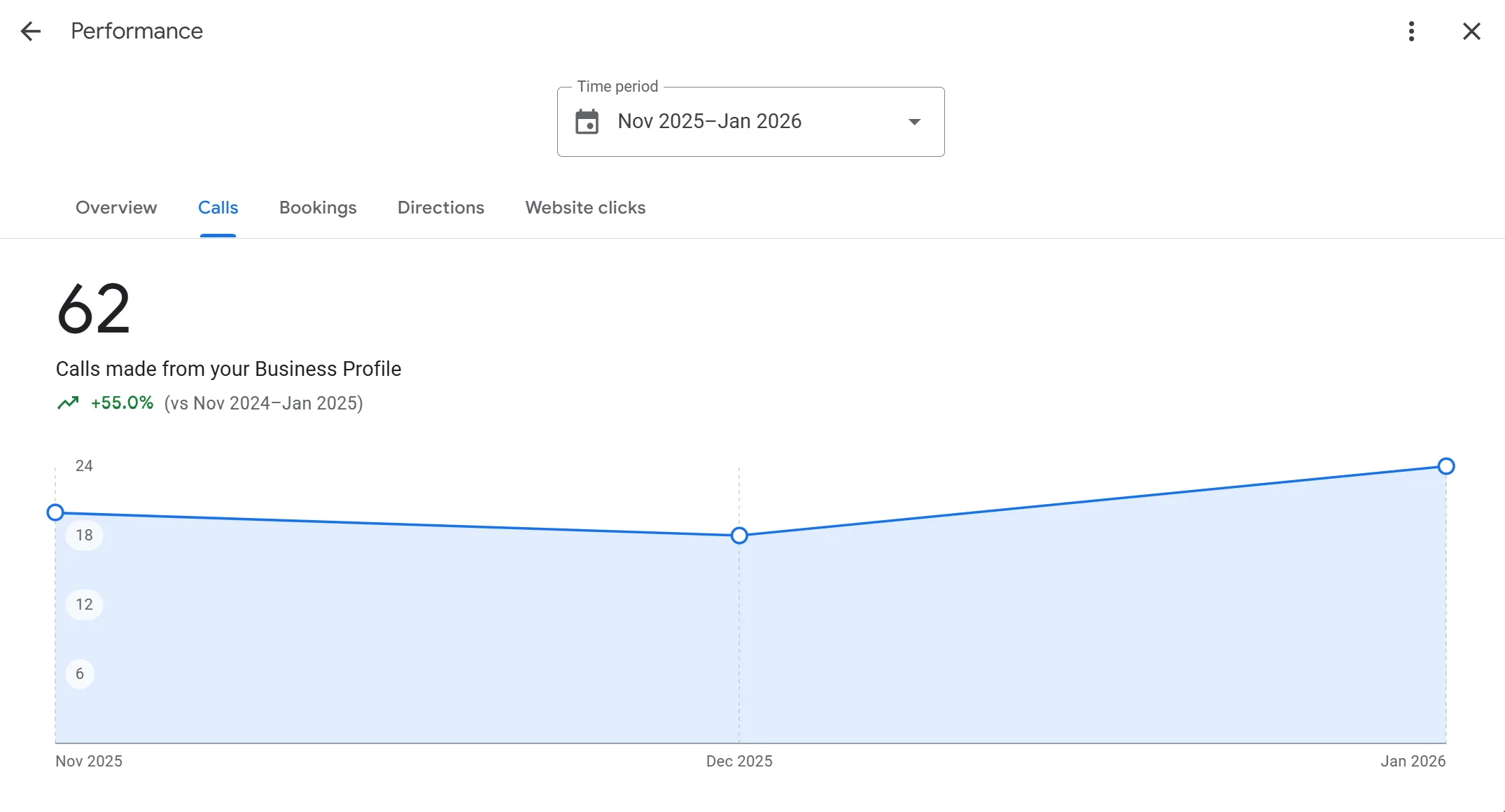
| Calls, website clicks and direction requests | Business Profile performance | How people act on the profile, month by month |
| Enquiries by job type and suburb | Your own enquiry records or call tracking | Whether enquiries match the work you want more of |
| Reviews by job type | The profile itself | Whether finished projects turn into reviews that mention the work |
Where landscaping work comes from
Landscaping searches pair a job with a suburb. "Retaining wall builder Buderim". "Garden design Noosa". We build your pages around those pairings so the enquiry comes straight to you.
Coastal blocks, sloped sites and new estates each create their own work. Sloping suburbs feed retaining wall searches, while new estates want turf, fencing lines and full yard establishment. Your visibility should match the terrain you service.
Big projects start months before the first dig. Homeowners research designs over winter and book in spring, so the landscaper they keep seeing in search wins the job before competitors know it exists.
Questions we get asked
When should a landscaper start SEO?
A landscaper whose busy season is spring should start SEO in autumn or early winter, because new pages and profile changes take months to show their effect. Google's guidance on hiring an SEO suggests asking what results to expect and in what timeframe, and an honest answer is a range of months. Starting early gives new pages time to be crawled and tested before homeowners book their spring projects.
Will I still get enquiries in winter?
Winter enquiries usually come from structural, drainage and design work, which homeowners book outside the planting season. Pages for retaining walls, drainage and garden design keep answering those searches through the cooler months. Nobody can promise a set number of winter calls, but a site that only promotes garden makeovers gives winter searchers nothing to find. Winter is also when design clients research, so it suits publishing project pages.
Should a landscaper publish prices on their website?
A landscaper doesn't need to publish fixed prices to answer cost searches. A cost guide can explain what changes the price of a job, such as machinery access, slope, soil, drainage, materials and plant sizes, and when council or engineering sign-off adds to the scope. That answers the homeowner's question honestly and filters out poor-fit enquiries, without locking you into figures that change with every site.
Do I need my QBCC licence number on my website?
If your work needs a QBCC licence, yes. The QBCC says advertising must include the name you're licensed under and your licence number, and that this covers websites, social media pages and online directories. A trading name alone isn't enough, because the QBCC licenses the name on the licence. Landscapers working outside Queensland should check the advertising rules of the regulator in their own state.
Is SEO worth it for a small landscaping business?
SEO is worth it for a small landscaping business when the work it wants more of is something people search for in the suburbs it serves. Design, construction and maintenance buyers all look online before calling. It makes less sense for a business already booked out through referrals with no room for more work. The trade-off is months of steady effort before the effect shows.
What is the most effective way to advertise a landscaping company?
A sound mix for most landscaping companies is a well set up Google Business Profile, service and project pages that can rank in organic search, and reviews from every finished job. Lead platforms can fill gaps, but the platform sets the rules and the enquiries stop when you stop using it. Google Ads can cover the months while organic pages build; the SEO versus Google Ads guide compares the two.
Can ChatGPT do SEO for a landscaping business?
ChatGPT can help draft pages, suggest headings and tidy wording, but it can't do the work that decides local results. It doesn't know which jobs you've finished, can't photograph them, can't confirm your licence and can't ask your clients for reviews. Anything it drafts needs checking against the facts of your business before it goes live, because a wrong claim about licensing or service areas does more harm than no page.
Can a beginner do SEO for their own landscaping business?
A beginner can do much of the groundwork: set up the Business Profile properly, write a page for each main service, publish project pages and ask every client for a review. Outside help makes sense when time runs short or technical problems appear. Google suggests asking any SEO for examples of past work, whether they follow Google Search Essentials, and what results to expect in what timeframe, and warns against anyone guaranteeing rankings.
Keep exploring

Want the phones ringing?
Tell us your suburb and your trade. We'll show you which searches and suburbs we'd target first.