
Call Tracking Services for Australian Businesses
Call tracking answers one question about your marketing: which part of it made the phone ring. Smart Local traces every call to its source, whether that came from Google Ads, SEO, your website or one specific campaign. Visitors are shown different numbers depending on where they arrived from, so a call can be matched to the visit behind it. That data then feeds Google Ads and your analytics, so campaigns get optimised on real call conversions rather than clicks. Smart Local has helped businesses go from guessing where calls come from to seeing every enquiry, lead source and conversion. Send through what you're running now and ask what the tracking would cover.


Who This Is For and What Usually Goes Wrong
A phone rings, the job gets booked, and next month's budget goes out unchanged because nobody can say which part of it worked.
That is where a lot of Australian owners sit. At 30 June 2026 there were 2,814,778 actively trading businesses in this country, and the large majority of them do not employ anyone. Another 689,600 have one to four staff. Owners answering their own phone, between jobs.
The ground keeps shifting under them. In 2025-26, 460,461 businesses opened and 375,331 closed. Spending that worked last year can quietly stop working, and a call log with no source attached gives no warning.
Smart Local puts the point plainly: call tracking is only useful when the numbers turn into decisions. The setup traces every enquiry back to the channel that drove it, so you can spend with confidence. Without that visibility over enquiries, lead sources and conversions, it is easy to keep paying for campaigns that look busy and never convert.
What makes this hard to do by hand is that the channels overlap. Google decides local results on relevance, distance and prominence, and says outright that there is no way to pay for a better local ranking. So one customer can find you in Maps, in a search result or through a paid ad inside the same week. Dynamic number insertion answers that by showing different numbers to visitors based on where they came from, tying each call to the visit behind it.
The tracking then joins the rest of your marketing, tying into your SEO, Google Ads, website and local campaigns, so what drives calls and revenue sits in one picture.
If your business gets paid after a phone call, this is the service that tells you where those calls came from.
Problems we fix
You cannot say which channel booked last month's jobs.
In a competitive suburb, calls arrive from Google Ads, SEO, Maps and direct searches at once. Without knowing the source, the campaign worth more money and the one worth cutting look the same. Every call is traced back to its source: Google Ads, SEO, your website or a specific campaign.
A campaign looks busy and the phone stays quiet.
With no visibility over enquiries, lead sources and conversions, there is nothing to check the activity against. It becomes easy to keep paying for campaigns that look busy and never convert. Call data is connected to Google Ads and your analytics, so the ad account is tuned on calls that came in.
Enquiries get missed and nobody finds out.
With no recording, there is nothing to review once the call has ended. Missed opportunities stay invisible. Calls are recorded, so you can review how customers behave and catch what was missed.
You do not know which suburbs deserve more attention.
One phone number across a whole service area returns one total, split by nothing. In a growing area, traction is worth spotting early so you can back it before competitors catch on. Calls are tracked by location, campaign and service area, showing which suburbs generate the most enquiries.
Calls, ads, search and the website are measured in separate places.
Call records sit in one place and campaign performance in another. Joining them is a deliberate piece of setup. One picture of what drives calls and revenue is what makes the spending decision obvious. Your call tracking ties into your SEO, Google Ads, website and local campaigns.
The tracking was set up once and never looked at again.
Smart Local treats accuracy as ongoing work, refining tracking over time on real performance data. The numbers are only useful when they turn into decisions. Full setup is handled for you, then refined over time so the data stays accurate and useful.
What Smart Local's Call Tracking Includes
Seven pieces of work make up the service. Calls get traced to the source that produced them. The number shown on your website changes with where the visitor came from. Calls are recorded for review. The results feed back into Google Ads and your analytics. Tracking is split by location, campaign and service area, reported in plain English on volume, sources, duration and outcomes, and kept accurate over time.
- Call attribution and source tracking Every call traced to its source, whether that's Google Ads, SEO, your website or a specific campaign. The same job can come from Google Ads, SEO, Maps or a direct search, so each call is traced back to the one that produced it.
- Dynamic number insertion Different numbers shown to visitors based on where they came from, so every call is matched to a visit. The number on the page changes with the visitor's source, set up around how customers in your area engage, from click-to-call mobile searches to local service pages.
- Call recording and insights Recorded calls you can review, so the sales conversation improves and missed enquiries get spotted. Reviewing real calls shows how customers behave and which opportunities were missed. Smart Local's stated aim is numbers that turn into decisions.
- Conversion tracking integration Call data connected to Google Ads and your analytics, so campaigns are judged on calls. Campaigns get optimised on real call conversions rather than clicks, and the same data ties into your SEO, website and local campaigns.
- Local and multi-location tracking Calls split by location, campaign and service area across everywhere you work. Splitting calls by location and service area shows which suburbs generate the most enquiries, and in growing areas that shows traction early.
- Reporting and performance analytics Plain-English reporting on call volume, sources, duration and outcomes. Reports cover volume, sources, duration and outcomes in plain English, refined over time on real performance data.
- Setup and ongoing optimisation The whole setup handled for you, then kept accurate as your campaigns change. Full setup is handled for you, then refined over time so the data stays accurate and useful, with no lock-in contract on the arrangement.
How Smart Local Tells One Call Source From Another
Dynamic number insertion sounds technical and isn't. The phone number on your website changes depending on where the visitor came from, so someone who clicked a Google ad sees a different number from someone who arrived through a search result. When the phone rings, the number that was dialled points back to that one visit.
Maps is the source owners find hardest to read. Google decides its local results on relevance, distance and prominence, and states there is no way to pay for a better local ranking. So a customer can reach you through the map listing, an ordinary search result or a paid ad inside the same week.
Smart Local sets the tracking up around how customers in your area engage, from click-to-call mobile searches to local service pages and paid campaigns.
The same data goes back into the ad account, where campaigns can be optimised on real call conversions rather than on clicks. As a Google Ads example from Smart Local's client work, Bob Gunn Termite Solutions recorded 231 conversions, up 124.3%, while cost per conversion fell 20.5%. That was Google Ads work for that client, not a call tracking result.
Reports and Recordings You Can Actually Use
Reports come back in plain English: how many calls arrived, where they came from, how long they lasted and how they ended. Volume on its own is a thin number, so duration and outcome sit in the same report.
Recordings sit beside the numbers. You can review calls to see how customers behave, sharpen the way enquiries are handled, and catch the opportunities that were missed. Smart Local's stated aim: numbers that turn into decisions.
The setup doesn't stay still either. Smart Local refines your tracking over time on real performance data, after handling the full setup at the start.
Tracking Calls Across Suburbs and Locations
Calls are tracked across locations, campaigns and service areas, which shows which suburbs are generating the most enquiries. That is a practical answer to which area deserves the next page or the next ad.
In growing areas, tracking shows what is gaining traction early, so you can back it before competitors catch on.
Operators with more than one site worry about one location doing well while the others sit flat. Billabong Pool Service had Business Profile interactions rise 338% across three Sunshine Coast locations in six months, with the three measured separately. That was Google Business Profile work for that client rather than call tracking.
Demand for this is regional too. Over the last 90 days the search 'call tracking melbourne' put Smart Local's own site in front of searchers 10 times, at an average position of 37.3, well past the first page of results. 'Call tracking services perth' did the same 6 times, at position 29.5. Neither returned a click.
Getting a Price for Call Tracking
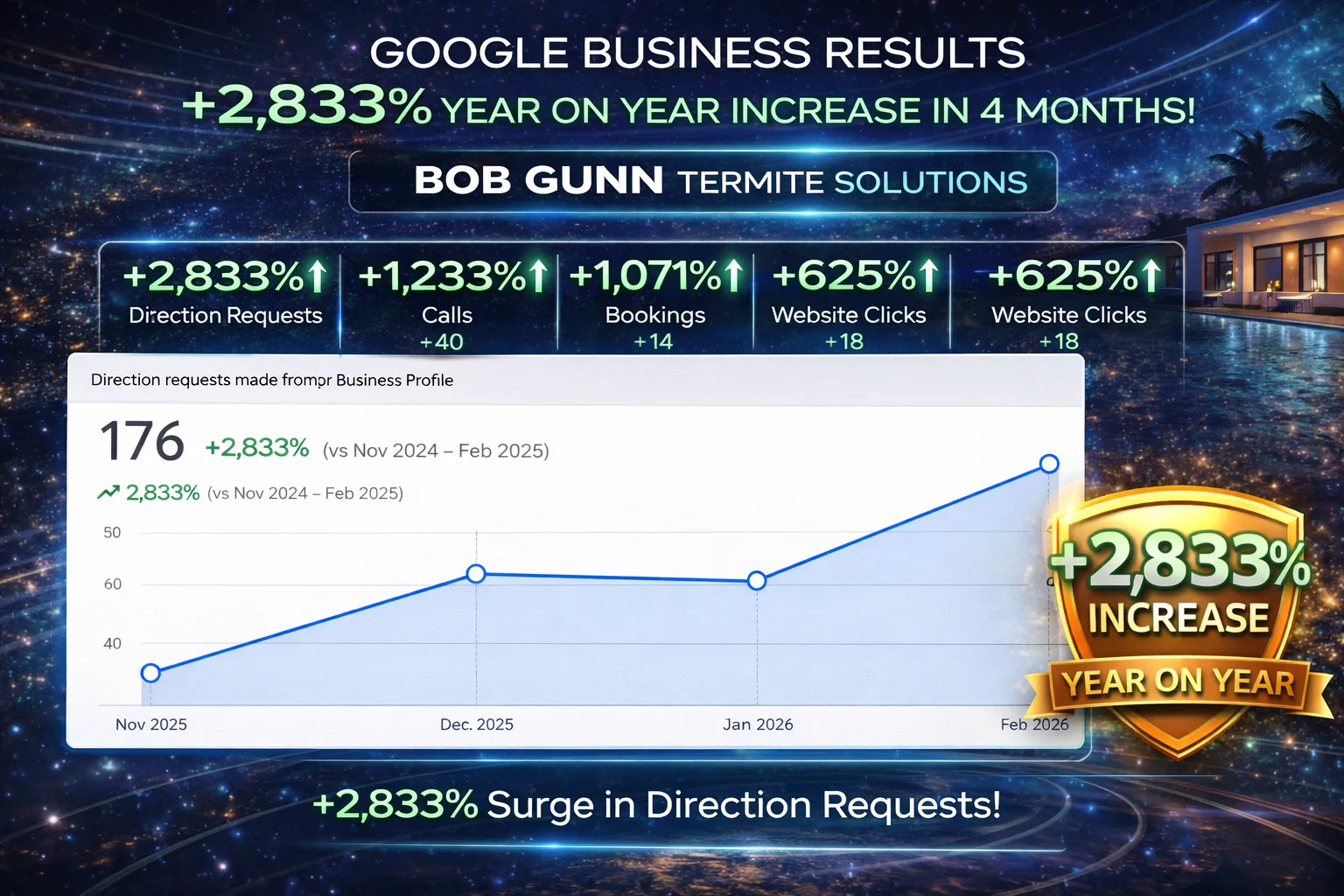
Two Smart Local client records measure phone calls directly. Bob Gunn Termite Solutions had calls rise 1,233% and direction requests rise 2,833% over four months of Google Business Profile work. Burpengary Concreting had calls rise 55% in three months, with organic searches and ranking keywords still climbing across six months.
A third measured something else. Secrets on the Lake at Montville had website conversions rise 236% in 90 days, a website conversion result rather than a call result.
Each of those belongs to the named client beside it and records work already done, not a forecast for your business.
Smart Local has worked in digital marketing for more than 20 years. It has built more than 200 websites and generated more than 1,000,000 leads for clients. It holds more than 1,000 documented client success stories. Smart Local has taken client businesses to first place in suburb searches: BJH Law in Noosa had all eleven of its target keywords ranking first, from civil litigation through to criminal defence. Bob Jane T-Marts at Buderim had Google profile visits rise 428% while holding first place in its local results. Smart Local runs a No Lock-In Contracts policy. Google states that nobody can guarantee first place and warns buyers away from any provider claiming otherwise. The client results above belong to named businesses and record work already done, rather than predicting what a new client will get.
Questions we get asked
What exactly is call tracking?
It traces every call your business receives back to its source: Google Ads, SEO, your website or one specific campaign. Different numbers are shown to visitors based on where they came from, so each call is matched to the visit that produced it. Reports then cover call volume, sources, duration and outcomes in plain English.
Is call tracking worth it for a small business?
Most Australian businesses are small: at 30 June 2026 there were 2,814,778 actively trading businesses, the large majority of them not employing anyone, and another 689,600 employing one to four people. 'Call tracking for small business australia' is one of the searches Smart Local's own site appears for. Every call still gets traced to its source, and the report still covers volume, sources, duration and outcomes.
How does call tracking connect to my Google Ads account?
Call data is connected to Google Ads and your analytics, so campaigns get optimised on real call conversions rather than clicks. It ties into your SEO, website and local campaigns too, putting what drives calls and revenue into one picture. As a Google Ads example from Smart Local's client work, Bob Gunn Termite Solutions recorded 231 conversions, up 124.3%, with cost per conversion down 20.5%. That was a Google Ads result for that client, not a call tracking result.
Do you track calls across several locations?
Yes, calls are tracked across locations, campaigns and service areas, which shows which suburbs are generating the most enquiries. Smart Local has handled several sites for one client before: Billabong Pool Service had Business Profile interactions rise 338% across three Sunshine Coast locations in six months, which was Google Business Profile work for that client rather than call tracking. In growing areas, tracking shows what is gaining traction early.
Can you guarantee more phone calls?
No, and under Australian Consumer Law a business must be able to prove any performance claim it advertises, and a claim can mislead even where nobody intended it to. Google says the same about rankings: nobody can guarantee first place, and it warns buyers off any provider that claims to. What can be shown is work already done for named clients, such as Burpengary Concreting, whose calls rose 55% in three months.
What does call tracking cost?
What the work covers changes from one business to the next: it can be numbers swapped on a single website by visitor source, or calls tracked across several locations, campaigns and service areas. Setup is handled for you, then refined over time. Contact Smart Local with what you're running and ask for a price, with no lock-in contract on the arrangement.
Am I locked into a contract?
No, Smart Local operates a No Lock-In Contracts policy. The tracking is refined over time on real performance data, with reports you can read.
Keep exploring

Want the phones ringing?
Tell us your suburb and your trade. We'll show you exactly where the calls will come from.