
Hyper Local SEO for the searches people make in their own suburb
Hyper Local SEO is local SEO narrowed to the named suburbs, postcodes and neighbourhoods where you want more work, and Smart Local's Hyper Local SEO services pick those suburbs, then build your Business Profile, page, review and link signals in each one. When someone searches for your service in their suburb, Google shows whoever has the strongest local signals there. Each priority suburb gets its own research, its own page and its own line in the report, instead of one campaign for a whole city or region.


Why choose us for Hyper Local SEO
Hyper Local SEO narrows the fight. Instead of competing across a whole city, we target the exact suburbs and pockets where your best customers search, and where competition is often thinner.
Google ranks local results on proximity, relevance and trust. We build all three for each area you target, through your Google Business Profile, suburb pages and GPS local signals that prove you genuinely work there.
At the time of writing (November 2026), Google's Business Profile help names those factors relevance, distance and prominence, and says there's no way to request or pay for a better local ranking. Distance is measured from the person searching, so you can't move it. The work goes into relevance and prominence, starting in the suburbs close enough to your base that distance isn't working against you. Our Google Maps ranking service does the same work on the parts of a listing you can influence, then checks the result across your whole service area.
Smaller areas are easier to win and easier to hold. Once you rank in a suburb, steady upkeep works to protect that spot while the next area gets built.
You see every move in your reporting, suburb by suburb. And with no lock-in contracts, we have to keep earning your business with results.
What's included
Micro-area research
We find the suburbs and pockets near you where demand is real and the top spots are winnable. Your own records come first: where past jobs were, which suburbs callers name, and the search terms in your Business Profile performance report. Then travel time from your base, the value of the work in each area, and how strong the profiles already showing there look.
Google Business Profile tuning
Categories, services and service areas set so Google knows exactly which neighbourhoods you belong in. At the time of writing (November 2026), [Google's Business Profile guidelines](https://support.google.com/business/answer/3038177?hl=en) ask for the fewest categories that describe the core business, and [Google's service area help](https://support.google.com/business/answer/9157481?hl=en) allows up to 20 service areas, set as suburbs, postcodes or cities rather than a radius. Posts about recent local jobs are kept current, because [Google archives posts older than six months](https://support.google.com/business/answer/7662907?hl=en) unless a date range is set. Our [Google Business Profile optimisation](/services/google-business-optimisation/) service covers the monthly profile work, and the [Business Profile checklist](/resources/google-business-profile-checklist/) covers the full set-up.
Suburb landing pages
A page for each target area, written for the people who live there rather than copied and renamed. [Google's spam policies](https://developers.google.com/search/docs/essentials/spam-policies#doorways) list pages targeted at specific regions or cities that funnel users to one page as doorway abuse, so a page is only built when there's something true to say about the work in that suburb. The pages are written through our [Suburb SEO](/geo-seo/suburb-seo/) service.
GPS local signals
Location signals that build your relevance inside each suburb you want to win.
Citations and consistency
Matching business details across directories, so Google trusts you in every area you target. Name, address or service area, phone number and hours are checked against your Business Profile, and old listings carrying a former number or address are corrected or closed. Our guide to [business listing accuracy](/resources/business-listing-accuracy/) shows what gets checked, and our [citation building](/services/citation-building/) service finds, fixes and builds the listings.
Review momentum
A steady flow of reviews from real jobs in real suburbs. [Google says](https://support.google.com/business/answer/7091?hl=en) more reviews and positive ratings can help a business's local ranking, and its [Maps content policies](https://support.google.com/business/answer/2622994?hl=en) ban offering incentives for reviews or asking only happy customers. [The ACCC warns](https://www.accc.gov.au/business/advertising-and-promotions/online-reviews-for-product-and-services) that incentives for positive reviews risk breaching the law. So the request goes to every customer after the job, and anyone who mentions their suburb does it in their own words.
Local links and mentions
[Google's Business Profile help](https://support.google.com/business/answer/7091?hl=en) says prominence takes into account how many websites link to your business. Genuine local sources come first: trade associations you belong to, suppliers that list the installers they work with, community groups you're part of, and local news about real work. Bought links and bulk link swaps are left out, because [Google's spam policies](https://developers.google.com/search/docs/essentials/spam-policies#link-spam) class buying links for ranking purposes as link spam.

Hyperlocal SEO versus local SEO: where the line sits
Local SEO is the work that helps nearby customers find your business when they search for what you do: in Google Maps, the local results on Google Search and the AI answers that draw on the same information. It uses the Business Profile, the website, directory listings, reviews and links, usually aimed at a town or region. Hyperlocal SEO uses the same tools but narrows the target to named suburbs, postcodes or pockets, then decides the order they're worked in. It's a planning layer on top of local SEO, and most businesses need both.
It also sits beside narrower Geo SEO services, and each leads on a different problem. Map Pack SEO works on the three map results shown above the web listings. Map Expansion is for a business that only appears on Maps near its own address. Service Area SEO covers a trade that travels across a wide area. Hyperlocal SEO decides which suburbs come first and how deep each one goes.
| Question | Local SEO | Hyperlocal SEO |
|---|---|---|
| Unit of targeting | A town, city or region | Named suburbs, postcodes or neighbourhoods |
| Typical search | plumber Sunshine Coast | plumber Currimundi, or plumber near me typed from inside Currimundi |
| Website pages | Service pages and a regional location page | A page per priority suburb, only where there's real local detail to show |
| Business Profile | Categories, hours, photos and reviews | The service area list, posts about local jobs, reviews from customers in each suburb |
| Order of work | Usually everything at once | Suburb by suburb, then out to the neighbouring ones |
| How progress is read | Region-wide rankings and leads | Rankings and enquiries for each suburb |
How the target suburbs get chosen
The first list comes from your own records, before any keyword tool. Job addresses, invoices and call notes show where work already happens, and those suburbs are where you have natural relevance and reviews to build on. Keyword research then confirms whether people there search for the service by suburb name.
Hyperlocal SEO suits businesses that travel to customers or draw from a handful of nearby suburbs: trades, cleaners, removalists, clinics with a local catchment. It's a weaker fit for a business that sells statewide with no local service area, or one that can't take more work where it's being targeted. If the calendar is already full in one area, the effort is better spent in the next.
A first group of three to five suburbs is usually workable for a single-location business: enough to compare against each other, few enough to do every one properly.
| Input | Where it comes from | What it tells us |
|---|---|---|
| Past jobs | Your job records and invoices | Where you already have relevance and reviews |
| Demand | Keyword research and your profile's search terms | Whether people in that suburb search for the service by name |
| Travel time | Drive time from your base or crew locations | Whether the work can be reached on time and at a sensible cost |
| Job value | Your own job mix | Which areas send the kind of work you want more of |
| Competition | The profiles and pages already showing there | How much effort a top spot is likely to take |
| Capacity | Your bookings calendar | Whether more enquiries from that area can actually be served |
How an engagement usually runs
The work follows a fixed order, so every suburb gets the same checks and nothing goes live before the basics are right.
- AuditThe Business Profile, website, directory listings and reviews are checked first, along with mobile page speed and whether the phone number is a tap-to-call link on every page.
- Choose the first suburbsThe inputs above produce a short priority list, agreed with you before any page is written.
- BuildService areas and posts on the profile, a page for each priority suburb, listing fixes and a review request routine go in together, so each suburb gets every signal at once.
- Technical checksPages carry LocalBusiness structured data that matches the profile. Google's structured data guidelines say that using structured data doesn't guarantee a feature will show, so this is about consistent details rather than a ranking switch.
- ReviewSuburb results are read monthly and the plan is reviewed each quarter: what moved, what stalled and why.
- ExpandOnce a suburb is won, it keeps getting upkeep while the main effort moves to the next ring of neighbouring suburbs.

A hypothetical example: one plumber, three suburbs
Say a plumbing business based in Caloundra wants more work close to home. This is an illustration, not a client. Its job records show most recent work in Currimundi, Pelican Waters and Golden Beach, while its marketing has been aimed at the whole Sunshine Coast.
Those three suburbs become the first group. The Business Profile lists them as service areas, and each gets a page a resident would recognise: the jobs the business has done there, how far the van travels from Caloundra, photos from local jobs taken with the customer's permission, reviews from people in that suburb, and answers to the questions locals ask. If the plumber can't name real work in a suburb, that suburb waits.
A few months in, the owner reads the report suburb by suburb. Suppose calls from Currimundi pick up while Golden Beach stays flat. The next step is finding out why: stronger competitors, a thinner page or fewer reviews from there. Little Mountain and Kawana only join the plan once the first three are holding.
The usual mistakes would show up fast in a plan like this: copying the Currimundi page and swapping the name for twenty other suburbs, listing service areas the van never goes to, spreading the effort across the whole coast at once, and judging success by a ranking screenshot instead of the calls that came in. Our guide to when local landing pages deserve indexing covers the page side in more detail.
How progress is measured, suburb by suburb
Hyperlocal reporting has to be honest about what the tools can and can't see. Google measures distance from the person searching, so rankings shift with where they stand, and one ranking check can't describe a whole suburb. The report combines several sources and says which question each one answers.
- Rankings by suburbSearches such as the service plus the suburb name are checked from points inside each target suburb, not from our office.
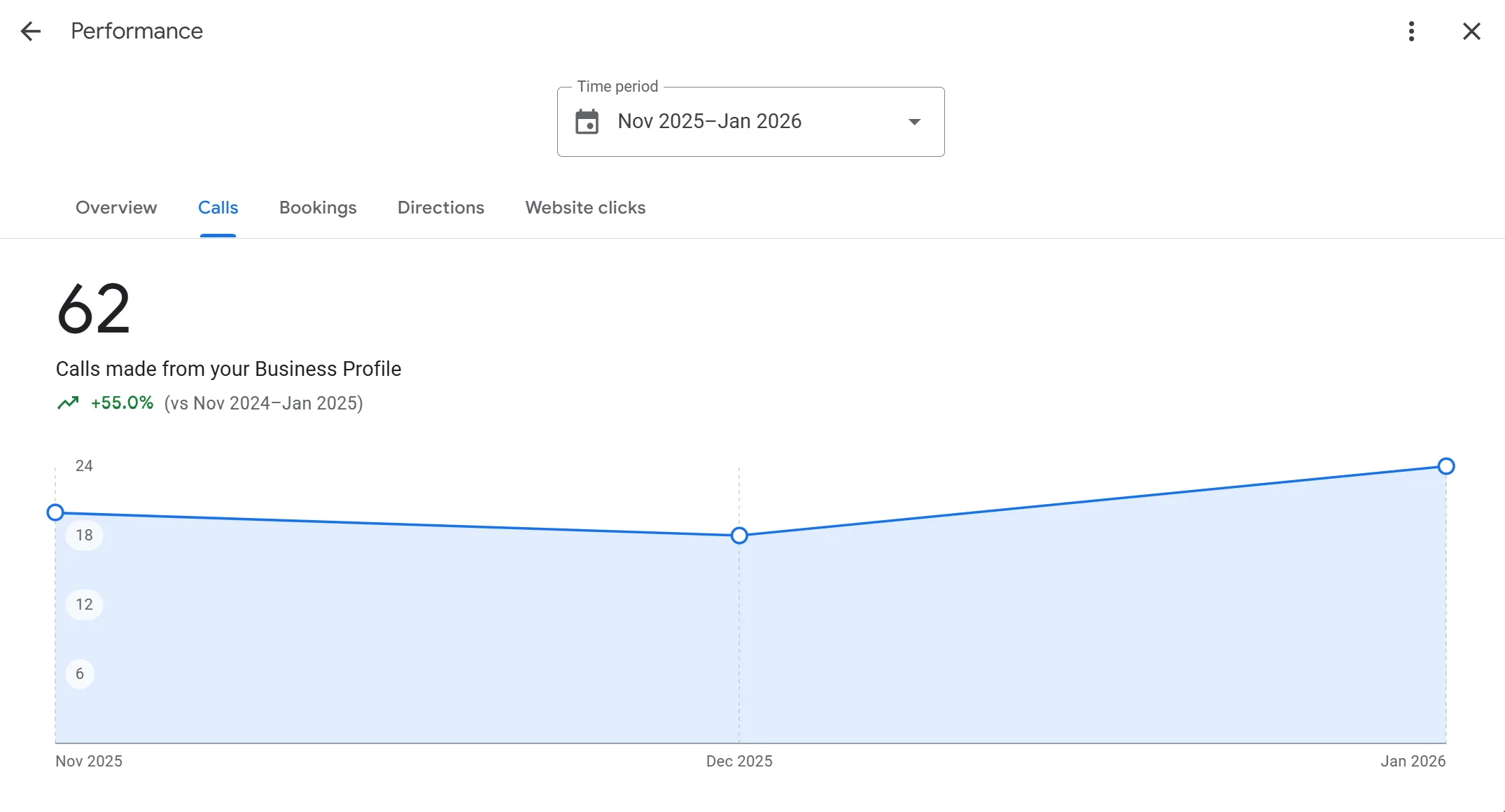
- Business Profile performanceGoogle's report shows calls, direction requests, website clicks and the search terms people used. It covers the whole profile, so it shows the trend rather than which suburb a call came from.
- Search ConsoleClicks and impressions for each suburb page and query. Location is reported by country only, so the page and the query carry the suburb detail.
- AnalyticsGA4 has a City dimension, which can be broader than a suburb, so it's read as a rough guide only.
- Job recordsThe suburb on each booked job, plus asking new customers how they found you, fills the gap the tools leave.

Made for tight local markets like ours
The Sunshine Coast is a string of suburbs with their own names and their own searches. Someone in Buderim types Buderim. Someone in Caloundra types Caloundra. Ranking for the wider region means little if you miss those searches.
Hyper Local SEO wins them one at a time. We start where you already have jobs, reviews and natural relevance, then push into the neighbouring areas with the best return.
Questions we get asked
How specific can hyperlocal SEO targeting get?
Hyper Local SEO targeting can get as specific as individual suburbs, neighbourhoods and postcodes. Our micro-area research finds the pockets near you where demand is real and the top spots are winnable. We then set your Google Business Profile categories, services and service areas so Google knows which neighbourhoods you belong in. The closer the match between your signals and how locals search, the better the results.
How much should I expect to pay for hyperlocal SEO?
The cost of hyperlocal SEO depends on the scope, so there's no fair figure before we've seen your situation. The main drivers are how many suburbs are in the first group, how competitive the searches are there, how much page writing each suburb needs, and the starting state of your profile, listings and reviews. A strategy review sets out the scope first, and our Geo SEO pricing page explains what shapes the cost.
Which parts of hyperlocal SEO can a business owner handle without an agency?
A business owner can handle the routine parts of hyperlocal SEO: choosing suburbs from job records, keeping the Business Profile current, asking every customer for a review and fixing old directory listings. The harder parts are suburb pages that avoid doorway patterns and measuring results per suburb when Google's own reports don't break down that way. Many owners keep the profile work and hand over the pages and reporting. Our guide to what SEO involves and what owners can do themselves covers the wider question.
Do I need a separate page for every suburb?
A suburb only needs its own page when you can write about that suburb honestly. A dedicated page gives Google a clear relevance signal for that area, but Google's spam policies treat region or city pages that funnel people to one page as doorway abuse. A suburb gets its own page once there's real local detail to put on it, such as jobs done there and reviews from residents. Nearby suburbs without that detail are covered on the main service page.
Does hyperlocal SEO help with near me searches?
Hyperlocal SEO helps with near me searches by working on the signals those searches use. A near me search names no suburb, so Google judges distance from what it knows about the searcher's location, then weighs relevance and prominence. You can't change where the searcher is standing. You can make sure your categories match the job, your reviews come from nearby customers and your pages cover the suburbs around you, which is the hyperlocal work. Our local SEO services handle the Business Profile and Maps work.
Does suburb-level SEO still matter when AI answers so many local searches?
Suburb-level SEO still matters for local services, because the signals it builds feed Google's local results. At the time of writing (November 2026), Google's Business Profile help lists relevance, distance and prominence as the factors behind local results. No one can promise how an AI answer will treat a business, and those products change often. Our guide on whether SEO is dead now that AI answers searches covers the wider question, and our guide to AI Overviews and AI Mode explains how they present local businesses.
Will targeting only a few suburbs limit my business's growth?
Targeting a few suburbs first lets your business grow in stages, because each suburb you win gives the next one a base to build from. Depth comes first, then spread. Smaller areas are easier to win and easier to hold. Once a suburb is won, we keep maintaining it and move the main effort into the neighbouring areas with the best return.
How long does hyperlocal SEO take to show results?
Quieter suburbs often move within the first few months of Hyper Local SEO work, and busier ones take longer. Smaller areas are easier to win, and competition in them is often thinner. Your reporting shows rankings for every target area, suburb by suburb, so you can watch the progress. Our guide on how long local SEO takes explains what speeds it up or slows it down.
Keep exploring

Want the phones ringing?
Tell us your suburb and your trade. We'll show you which searches and suburbs we'd target first.